
Grab a coffee and sit with me for a few – this one’s a longer one! As usual, supporting photos can be found here (look for the post with the matching lead photo).
After taking the AC bus to Dambulla, it was a slightly rude awakening to be unceremoniously dumped out in the midst of city chaos. We immediately drew the attention of multiple people who wanted to know where we were headed. Accustomed to this being a way of drivers getting business by giving you bad info (that bus doesn’t leave from here; the bus doesn’t leave for hours, let me take you around town; etc), we refused help and carried on about our business.
Our business, of course, being the search for snacks.
We jumped in a bustling food court nearby because the best food is almost always found around bus stations. Annnnnd we apparently found the exception to this rule. The food was bland, but the woman who served our table was a delight – so we’ll count it as a win. Lunch killed enough time for us to find out, unsurprisingly, that we could catch the bus to Kibissa by simply crossing the road instead of going to the other bus station like the drivers were telling us. We hopped onboard and paid a whopping 93 cents for the two of us. 30mins later, we were walking up a dusty track in scorching hot sun under the weight of our packs, not at all regretting the location of our lodge.
Niyagala Lodge is three individual cottages in Isuru’s (the owner’s) back garden. Compared to our Anuradhapura lodges, they were positively luxurious for a measly $9 extra per night – and that included breakfast! Isuru offered some suggestions about where we could go for a run, but warned that we shouldn’t go early or late in the day. We caught the suggestion, but didn’t think too much of it.
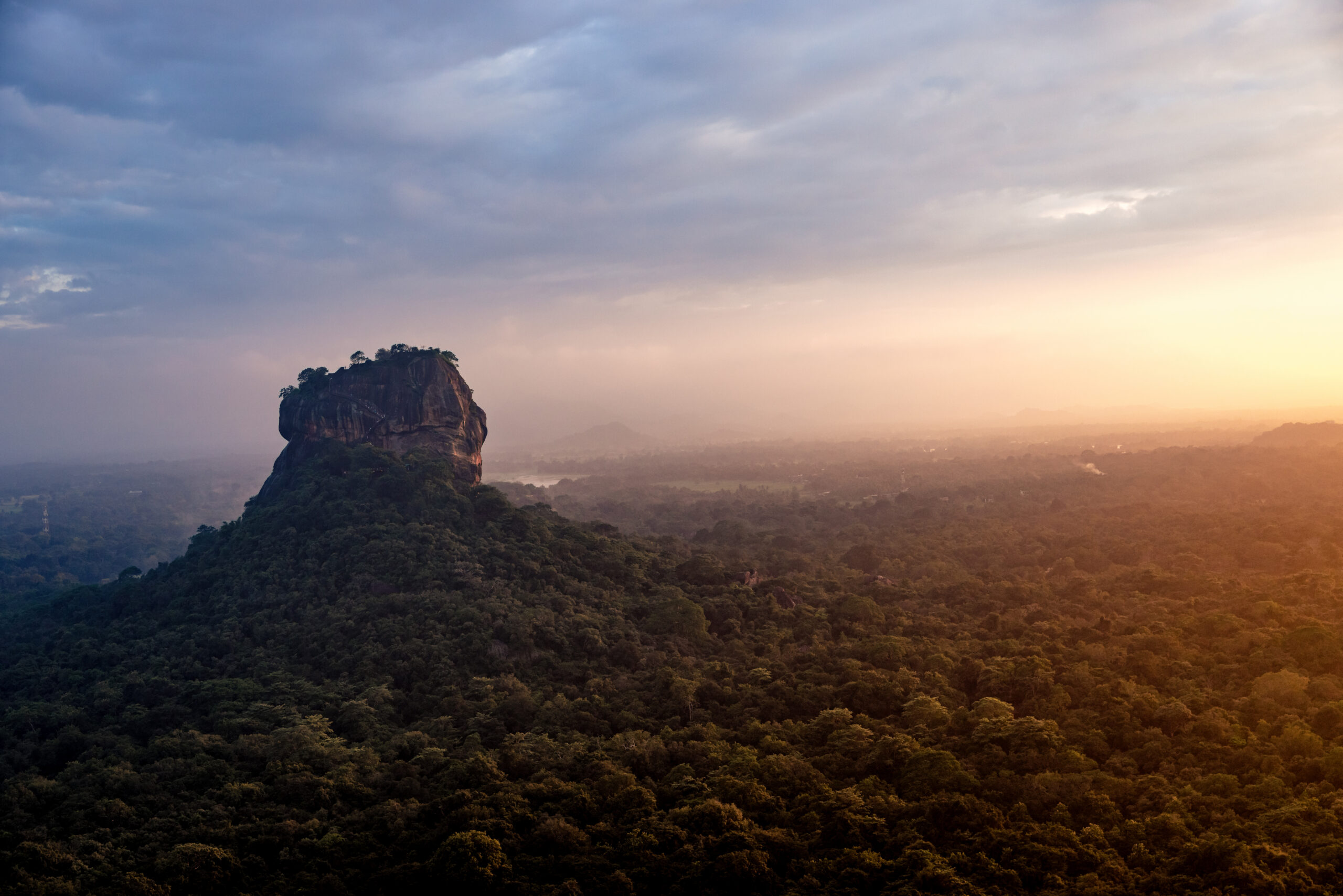
Sigiriya’s main draw is Lion Rock, a 200m-high hilltop fortress and palace built by King Kashyapa around 480 AD as a refuge from his brother, Mogallana, after usurping the throne (talk about sibling rivalry…). The surrounding grounds include a large water garden complex, which the king would enjoy during the dry season. Once he was defeated, the complex was transformed into a Buddhist monastery, and eventually abandoned in the 14th century before being “rediscovered” (take that as you will) by Europeans and then declared a UNESCO World Heritage Site. The area is also known for Pidurangala Rock, which looks out towards Lion Rock. Both are great sunrise and sunset spots and we had plans to check each out. There was a truly phenomenal amount of rain (think triple digits in a single day) forecasted for our time in Sigiriya, so we didn’t hold out hope for the best conditions, but tried to remain optimistic because we’d already watched the forecast update daily and the amount of rain decrease.
But first, given the advice not to run later, we immediately embarked on what felt like the world’s hottest run down a road that, judging by the excitement we caused, seemingly no Westerner has ever run down. We passed lots of happily waving local residents wearing mirthful grins, an entire community’s worth of dogs, and a driving range….aimed at an air force runway?? As we ran, clouds moved in and a light rain started and I could’ve just about cartwheeled with glee. Running in the rain is one of my favourite things, but you’ll perhaps be unsurprised to hear that the locals found the sight of two Westerners running in the rain even more bewildering than two Westerners running in the sun. Afterwards, we did dry-bag laundry (shaken, not stirred) and got our first lesson about life in Sigiriya: don’t count on clothes drying in a timely fashion.
We excitedly headed out for dinner at a well-reviewed spot nearby and had a laughably bad dinner of six flattened bites of chicken fried into little pancakes (albeit decently tasty pancakes) and a prawn “stew” that looked as though a yellow highlighter had exploded into a pot, to which they added cornstarch and vegetables. Feeling thoroughly dejected and now doubtful of our ability to find good food after two meals demonstrating the absolutely peak of mediocrity in the same day, we shuffled our way home… while quietly noticing that no one else was walking.
We had plans to hike Pidurangala Rock in the morning, so we met our tuk tuk driver, Gayan, at 6am and headed to the rock. In the fog. In the gradually increasing light, we paid our entrance fees and began our climb, which involved about 300 steps up before reaching a point with a fun bit of clambering to get up some gigantic boulders. In the fog. And then we followed a track around some truly enormous boulders to reach the flat top of Pidurangala, where we could sit and look out at Lion Rock. In the fog.
It was quietly peaceful to watch the mist undulate and shift around the looming shadow of Lion Rock, but as I sat and waited…and waited…and waited…I realised that I’d had higher hopes for this view than I’d originally allowed myself to believe. I sat with a bit of disappointment and then we agreed to try it again when there was a clear break in the weather. In the meantime, it was looking like the perfect day to head to Dambulla Cave Temple, since it was indoors, so we headed back down the mountain. Call me a sadist, but my spirits were buoyed by the squeals of terror coming from various tourists who were in the process of finding out they’d flipped to a bad page on this particular Choose Your Own Adventure story. Gayan drove us back to Niyagala Lodge (was it just me or did we travel at a notably higher speed now?), where Isuru had the most incredible breakfast banquet ready for us: egg hoppers, plain hoppers, string hoppers filled with coconut and jaggery, fruit, fresh juice, dhal wade (lentil fritters), and a pot of tea. Heaven – and not a single piece of dreaded papaya in sight.
A quick shower and we were on the bus back to Dambulla, this time armed with the knowledge of where we would not be eating lunch, and then a quick tuk tuk ride got us to the caves. Dambulla Cave Temple is actually five temples of varying ages that were built into a section of cave that is really quite impressive. Once again, we climbed hundreds of stairs alongside some people who looked like maybe they were acting in direct contravention of their cardiologists’ orders before handing our shoes over at the booth and continuing on into the complex. The caves sit at a balmy 86% humidity, furthering our acclimitisation efforts and, shockingly, not causing any damage to the paintings contained within each cave. The entirety of each cave is covered in frescoes and filled with religious icons (mostly Buddhas, but also some occasional Hindu references). Each cave is meant to depict a different stage in Buddha’s life, making each one feel quite magical and absolutely worth the climb up.
We proceeded to do the trip back to Kibissa in reverse order, with two key differences: we had an awesome lunch (kudos to Rangiri Luuv) and I made a friend on the bus! A little girl, about 2 or 3 years old, was seated with her family in front of me. She promptly took an interest in the foreigner seated behind her, and we spent 30 playful minutes laughing and enjoying one another’s company. At one stage, she got off the bench seat to go see her grandmother, who handed her some small items out of a plastic bag and indicated to her that she should pass me some. Into my hand landed some vibrant fuschia bell-shaped…. fruit? I gave it a taste and the closest comparison I can make is a crunchy-but-watery Granny Smith; I later learned that they were young roseapples. They’re delightfully refreshing. I passed some behind me to Rich, and then the Sri Lankan woman beside him also asked for some. And so came our first lesson in Sri Lankan property rights: share everything. This has since served me well on other bus trips and immediately helped me make new friends.
We jumped off at our stop, waving goodbye to my new little friend and trudging back up the dusty road to tell Isuru about our new treat. Along the way, we made sure to listen for the “HI!” that would inevitably be shouted just as we were almost out of earshot of one particular home. It seemed to take the kids an extra couple of minutes to muster up the courage to say hello, but it always echoed through the trees eventually and we always shouted back as little fingers, just barely visible between the tree branches, waved enthusiastically.
Clear skies that day meant we decided to give Pidurangala one more shot for sunset. We left a little early to make room for potential crowds and I’m thankful we did: we got caught in a logjam partway up the mountain at a point where the steps disappear and the scramble becomes more technical without warning. It’s also where traffic coming down off the peak funnels into a one-way system and generally causes all kinds of issues, including a total loss of patience in some tourists. While we waited for people to find their footing and make progress out of narrow channels moving down and through tricky sections of rock, a teenager came barrelling through the crowd by clambering along the rock just above shoulder height. He ended up hitting the same traffic jam that we all did and got told he needed to chill out. When he tried to proceed further and got told again, with less courtesy this time, his response in Russian-accented English was, “Yeah yeah. I’m better than you.”
I can assure you that was not well received.
I can also inform you that it took every ounce of my willpower to warn him about his finger placement instead of casually stomping on his digits when he chose handholds that were clearly in the path of advancing hikers (ie me, since I was in front of him – meaning he clearly was not, in fact, better than me in this instance).
We steered clear of this delightful tourism ambassador as soon as we could, and proceeded to enjoy a glorious view of Lion Rock, which rises starkly from the otherwise-flat countryside. We “ooohed” and “aaahed” as the sun dropped lower on the horizon and the sky split between yellow on the sunny side of the rock and blue on the shadowed side. Glorious.
The trip down was equally fraught with those who were short of patience and out-adventured by the challenge of climbing on the rocks, but we were clear and on our way soon enough. At the bottom, we ran into a little problem: we didn’t book Gayan to pick us up and quickly learned that the tuk tuk drivers run a little racket, charging peak pricing for tourists looking to get back to town. Once our negotiations finally netted us a ride, we learned the reason for Gayan’s slow morning drive and the total absence of people walking on the road near our lodge: the risk of elephants is legit. Our tuk tuk driver, clearly on edge, pointed out a couple of spots along the way where he usually sees elephants. So, tuk tuks after dark from now on. Got it!
Just to drive the point home further, as soon as we got back to Niyagala, Isuru told us an elephant had been at the fenceline right beside our cottage while we were out. It was hard to tell if it was a warning or excitement, but we took it as both.
Another dawn wake up call; another rock to climb. This time, we tackled the 1200 steps up to the top of Lion Rock. I’d been expecting the climb to be rather arduous, but we learned that the advantage of doing it in the dark is that you can see neither how far you’ve come nor how far you’ve got left to go. We arrived at the top in the gathering dawn light, just as the sky was beginning to brighten above a layer of cloud and the fog was still rolling across the landscape.
We watched for a few moments and then, true to us, started exploring and clambering around the fortress like the proverbial bear that went over the mountain. Watching the distant mountain range appear in muted pastel purples and blues through the cloud was such a beautiful head-shaker of a travel moment for me. There’s seemingly endless viewpoints (duh, I suppose – we were on top of a rock) from which to observe the changing views of the landscape below. The distant Buddha statue peered out from its fog bath, the sun bathed the morning hikers atop Pidurangala in a golden glow, and shadows began to form on Lion Rock as the sun gradually shifted above the clouds. We chuckled at an obvious Instagram photo shoot in progress, then began the return trek down the mountain and through the water gardens, where the rocks steamed under the heat of the sun and the macaques and langurs ran freely. As luck would have it, we timed our hikes perfectly; there were only two dry-and-clear sunrise/sunset periods during our entire stay and we took advantage of both.
An afternoon of laundry, shadebathing, napping and writing ensued. We also took a walk towards town, stopping at a local spot for barely-room temperature chicken curry and rice that felt juuuuuust questionable enough to make us wonder whether we’d regret our choice the following day. As the sun dropped lower, we were rested and looking forward to joining Isuru for an informal cooking class. We hopped in the tuk tuk and headed to town to collect ingredients: Chinese eggplant, tomato, onions, garlic, red lentils, green beans, okra, chicken, and a peculiar purple vegetable we’ve since learned is called dambala. Sometimes sold when green, sometimes sold when purple, it’s basically a winged bean and is chopped up for use in salad.
Time with Isuru is kind of entertaining: he’s an introvert who runs a business almost entirely dependent on successfully chatting with customers. The Man of Few Words set us up at a table, demonstrated how he wanted us to tackle each vegetable, and we got to work. The interesting part came when it was time to cook: Sri Lankans mostly use two-burner propane cook stoves, and we had 5 dishes to make. The clay pots that are always used for curry meals were all set out on the counter, so we worked on filling them, one by one, with another curry – all of which seemed to contain the same combination of spices in just slightly varied amounts.
Despite being an above-average consumer of coconut milk, I’ve never actually seen it made, so I was fascinated to see a rather scary-looking serrated-bladed contraption mounted to the countertop and learn that it is effectively a coconut drill: a hand-cranked tool that scrapes the flesh out of coconut halves. Once the flesh has been collected, you just add water, mash, and squeeze into a strainer. Voila! Not about to make it at home, but interesting to see, all the same.
The good news is that, when we sat down to eat, the temperature of the dishes reassured us that our seemingly-questionable lunch earlier that day probably wasn’t questionable at all – it likely hadn’t been sitting out for hours; it’s just impossible to keep all of the food warm when you only have 2 burners to work with.
We were joined at the dinner table by two Roman women on vacation who were great company. We chatted while we ate, gradually drawing conversation out of Isuru and watching happily as he became more comfortable and thus more animated. I’d like to credit our stellar company for being the cause of this, but it was probably also helped by the 8% beer. Over glasses of coconut arrack (also, perhaps, a contributing factor for his newfound ebullience), he taught us to say, “Saudiya puramu” (cheers!) and shared his story of travelling to Europe to visit a French friend he made through his business, and shared his dream of opening a parasailing and paramotoring business in Sigiriya. We headed for bed feeling stuffed full and hopeful for what the future held in store for him.
The following day, it was time to head for Kandy, our last stop in Sri Lanka’s Culture Triangle and the country’s second-largest city. We bid Isuru a fond farewell and asked him to send WhatsApp updates about the work he’s doing on the property so that we can keep in touch.
Grateful for: a cooking class that turned into a philosophy lesson