
We left Dean and Giselle at a restaurant in the medina in Marrakech and headed off.
Our target: the Sahara.
The goal: a night, possibly two, under the stars at a somewhat remote camp on the edge of Erg Chigaga, one of the area’s renowned giant dunes.
It was the type of adventure that gives Type A planners a good case of hives. We had a general target for the night, but no actual reservation and no confidence that we’d make it as far as we planned before darkness – and the risk of meeting camels on the roads in said darkness – set in.
What could possibly go wrong?!
It’s worth knowing that there are multiple ways of experiencing the Sahara. Like everything in Morocco, the quality of the experience depends on your research, budget, and the amount of time you have available. There’s “desert” immediately outside of Marrakech, but it’s man-made and serves tourists who are short on time but want to go home with bragging rights about riding a camel or a dune buggy. In my opinion, this option is one of the country’s greatest sleights of hand – only once you’re past the boundary do you become aware of the trickery in which you were immersed. As you leave the city behind, passing Ouarzazate and heading towards the Algerian border, you start to encounter the other options. There’s the luxury version of the Sahara: right on the edge of the dunes, small villages of glamping tents are strategically positioned and the experience comes replete with en suites with running water and camel rides into nearby dunes. When you talk to a Berber, though, you find out that locals don’t ride camels unless they’re elderly or infirm, so I’m not sure what that says of the visitors. Then there’s the budget and midrange camps located on the edges of the desert with shared bathrooms with cold water and lodging in basic tents with beds or roll mats on the floor.
We zipped out of Marrakech, past Sahara Disney, through Ouarzazate where we had particularly excellent grilled sandwiches at Snack Special Grillades El Bahja, and onward further into the gathering dusk. We had to make an overnight stop at Riad dar Zaouia, a guesthouse in the small village of Zagora which, had we not been so pressured for time, probably would’ve been an incredible place to stay awhile.
The welcome was true Berber hospitality: a booming voice offering rest, tea, and a genuine invitation to feel at home. We said yes to the offer of tea, despite the late hour and worry that it might keep us up for hours (Moroccan tea is made with green tea, offering a higher hit of caffeine than that to which we’d grown accustomed of late). Rich needed to unwind a little after a particularly taxing drive and sitting with a warm drink was a good chance to do that. Our room was simple but comfortable enough – and the place came with guard kittens, who seemed intent to patrol the outside wall of the property. I wouldn’t describe either of us as cat lovers, but guard kittens are a whole new category of cute.
We had an early breakfast while admiring the riad’s gorgeous interior garden the following morning, then got back on the road using directions from our upcoming host, Larbi. We were to meet him at a particular gas station about 10mins from his camp, which sits on the outskirts of Erg Chigaga.
Larbi is a Berber – one of Morocco’s traditional nomadic tribes of farmers. It’s important not to confuse “nomadic” with “homeless.” Their encampments, often elaborate and comprised of multiple structures, are often built using a variety of portable materials (tarps, carpets, and canvas) that are packed up when it’s time to move on. Nomads’ movements are determined by the availability of food and water for livestock; when the food source dries up, it’s time to go. Sometimes that may mean they’ve been somewhere for a few weeks, but that can also extend to many months. They often leave their structure(s) intact for other Berbers to use on their way through or for them to return to if it’s a seasonal camp.
Larbi greeted us warmly and gave Rich directions that soon led us to sand tracks that he offered to navigate for us, at which time we immediately realised he doesn’t know how to drive an automatic vehicle. Alongside the car’s engine, we breathed a sigh of relief as we parked the car and we were led from the car to the camp’s dining tent. Although it was midmorning, the heat was already rising and a dry, sand-whipping wind was picking up. Imagine sitting inside a hair dryer and you’re in the right proximity.
Lunch was served and we had time to rest (read: bake) in the large tent while we waited for the peak heat of the day to pass. I noticed an increasing compulsion to slug back water and greedily chugged my way through a bottle. Before loading up the truck, Larbi took my dupatta and fashioned it into a turban, protecting both my hair and face from airborne sand. “Ah! Now you are Fatima Berber,” he declared mirthfully. We hopped in the truck and set off in the direction of Erg Chigaga, the largest dunes in the region, where we’d camp overnight.
Along the way, I swallowed my fifth litre of water as spotted a pair of wild ostrich with at least two dozen chicks, grazing herds of camels, a solar-powered well, and a small herd of addax – a desert antelope with corkscrew horns and hide so white it felt like someone was shining a light on them. Clearly, these aren’t creatures with predators!
We watched as the landscape shifted between rocky sand and tiny dunes sprouting sparse vegetation. Then we arrived at a compact oasis with greenery so lush that it was abundantly clear as to why these sorts of pockets of vitality could be the subject of hallucinations. We moved further into the desert, the wind announcing its presence with increasing menace, the blue sky taking an increasingly dusty tint. Stepping out of the car at each of our waypoints and animal sightings, I deepened my understanding of the true function of turbans with their trailing tails commonly used as face coverings. When nature attempts to treat you to a complimentary facial peel, it’s best to be prepared.
The Google Maps summary describes Erg Chigaga as, “spacious, remote desert landscape featuring waves of large, wind-swept sand dunes.” I’m not sure a summary has ever been more accurate and yet simultaneously so understated.
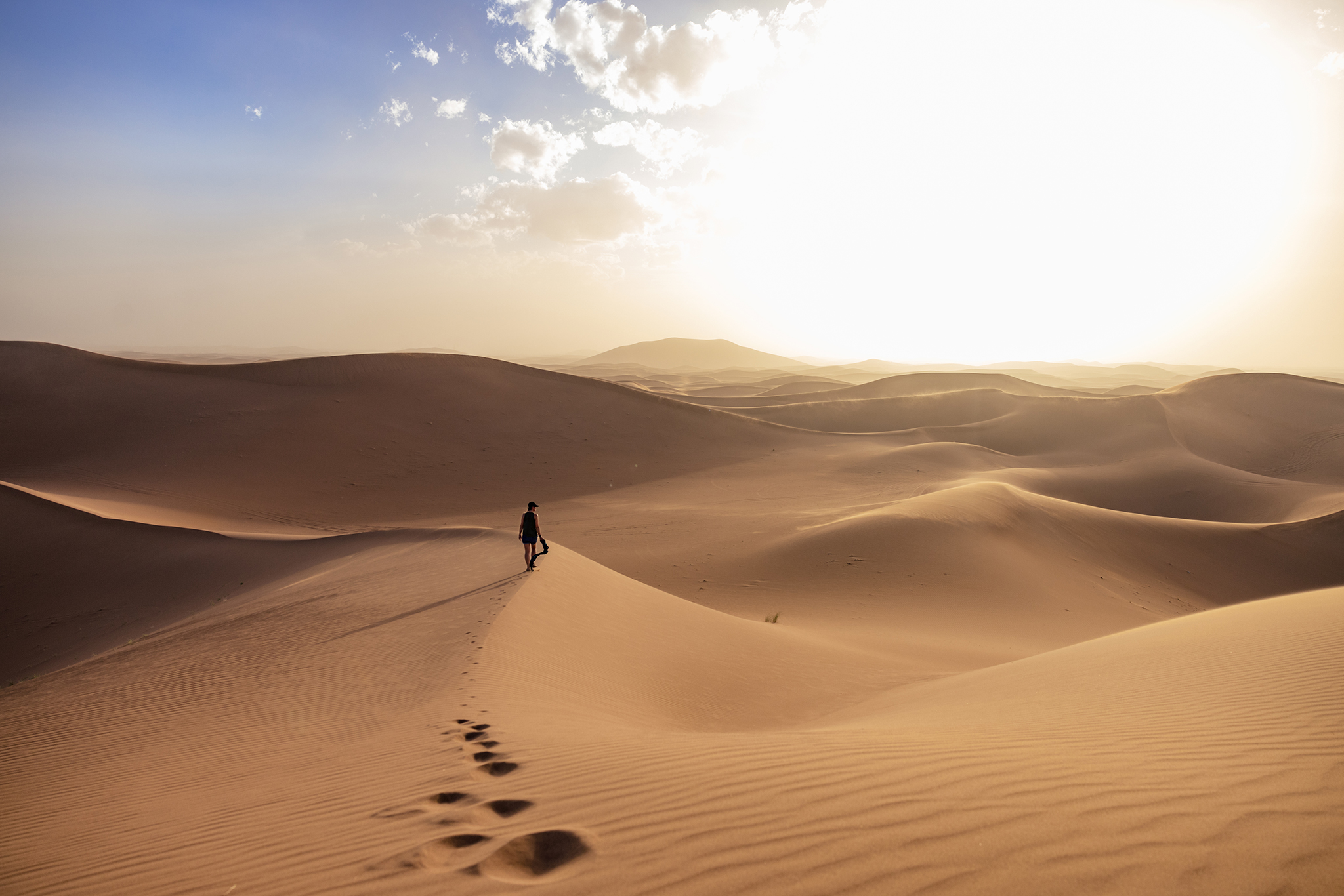
Arriving at the spot Larbi had chosen as our camp, I chugged back my seventeenth litre of water as we gawped at the dunes that towered around us. What was meant to be a little walk up and over the nearest set of dunes quickly became a full-blown hike as we struggled to stay atop the dunes, the deep, loose sand shifting beneath our feet.
We explored the area as Larbi prepared dinner, and I experienced increasing levels of distress as I attempted to keep my camera clear of the blowing sand. The desert had sucked the moisture out of my mouth, my eyeballs, my nostrils, and quite possibly my humour, and as Rich excitedly carried on ahead of me, I briefly struggled to remind myself of the magic of our situation.
As we crested one dune, we found another taller one waiting for us. We watched the wind whip sand off the peaks with the fluidity of water off of cresting waves. We watched sweeping patterns shift across the arcs of the dunes as unseen Saharan forces constantly rearranged the topography. I watched through my viewfinder as a tiny pair of figures trudged along the ridge of a dune far below us into the most perfect sunlight and celebrated when our paths crossed in the gathering dusk and I was able to send them the photos. As the sun set, changing the sand from brown to gold to amber, we marvelled at how vast this desert landscape truly was and how miniscule it made us feel.
And then, with the wave of an arm, Larbi signalled us back to our tent for a delicious tagine. We chatted with Larbi about life as a nomad and cultural details about Morocco. It was so interesting to see how nomadic life changes one’s experience of the surrounding world; how the absence of pop culture changes previously unrecognized social reference points and causes you to dig deeper into shared experiences. We also talked about the unique realities and challenges of business ownership when you have no fixed address, and helped him get his Google Business listing functional so that future guests would be able to call him directly instead of going through third-party booking sites. When your business is that small, having to pay commissions becomes a big deal.
Wind meant no campfire for us; it also meant an indoor kitchen. Cooking dinner in the tent meant that it seemed to be about 42C inside while we ate, so we spent some (marginally) more comfortable time outside to seek relief from being slow-cooked. I gleefully worked my way through a long exposure photo and, as I texted it to my friend, also marvelled at the fact that we had better cell reception in the literal middle of absolutely nowhere than we do in some areas around Cornwall (I’m looking at you, Warina). After enjoying the stars for a time, we decided to call it a night and reluctantly headed in to our own little clambake for the most restless sleep in recent memory.
In the morning, we enjoyed a Berber omelette before packing up our extraordinarily rustic canvas tent and making the drive back to our car. It was time to head for Turkiye.
Grateful for: a dupatta, a truckful of water