
**As always, you’ll find accompanying photos for this post here.
The train from Jaipur to Ranthambhore is so comparatively brief in the scope of the rest of our train travel that it felt like we blinked and it was time to disembark. It was 30mins from the station to our hotel and Uber doesn’t work in Ranthambore, so we learned we’d be paying extortionate rates for transportation, even if booked through the hotel.
We arrived at RajBagh by Aaryam and received a welcome so warm that it felt like we were staying with family. Vineet was so earnest in his efforts to make us feel at home that it seemed I could’ve asked for absolutely anything. All I really wanted were noodles – my shopping expedition at snack stalls near the hotel proved fruitless (noodle-less??), so I started with a very simple request, explaining that we’d been dealing with some stomach trouble and I was looking for simple instant noodles with salty broth. Of course! Absolutely! Translated instructions (“soupi noodles” if you’re wondering) were issued and our server vanished into the kitchen, returning a short while later with instant noodles that I’m convinced even now were my intestinal saviour. After 10 days of gradually declining appetite and eating one meal and sometimes a snack, the scales at Shapura House had revealed that my clothes hadn’t stretched like I’d suspected – I was, in fact, down a full 15lbs since we’d left home. This, however, was the day that marked my rebound and I was excited about it.
Our drive from the station revealed there was little to do on the edges of Ranthambhore National Park. Makes sense, since most people really only come to Ranthambhore for one reason: tiger safari. Our stay would be a short one and it appeared that this was a good thing. It seemed that the entire town had sprouted to support the tourism brought about by the national park.
Ranthambhore National Park is home to 75+ tigers in a space that’s really only large enough to serve as territory for 45 (there’s work being done to move some of the population, but progress is very slow), so chances of sightings are very high. We had two nights booked at RajBagh, with morning and afternoon safari drives during the one full day we had there.
When we first started planning India, I put Ranthambhore National Park on my “must do” list, largely because I was ignorant as to what else was available. As our time in India approached, we learned that there are actually 58 reserves and national parks in India dedicated to protecting 75% of the world’s population of Royal Bengal tigers. We had attempted to book a safari at Nagarahole or Bandipur National Parks when we were in Kerala, but learned that they had both closed to safari drives in November due to increased human-wildlife conflicts (both parks have only begun a phased reopening plan in the last few weeks), so we pivoted our plan back in January. We had looked at Jim Corbett National Park as our next best option based on population density within the park, but were advised by my partner company that Ranthambhore was a better option. I was sceptical, but decided to trust them.
Tiger safari bookings are best done months in advance, not four weeks in advance like we did. As a result, the jeeps were all fully booked, so we were booked in for two game drives in gypsy canters – about the size of a mini bus, they seat 20 passengers and have open sides and tops, with roll bars on the sides of the vehicle. They’re much louder and less nimble than Jeeps, but they’re still a vehicle going into the park in search of tigers, so we decided to be happy with what we could get and just hoped that we’d be with fellow passengers who understood the importance of quiet and patience.
Our first drive required us to be at the park gate for 6am. When our driver hadn’t shown up by 6:10, I was getting rather irritable. When you don’t know how a system works, it’s easy to settle into a scarcity mindset. The canter would meet us at the main gate by 6:30 and we were a 5min drive from the gate, so I had to remind myself that a 6am arrival is given because it’s advisable but probably not required.
We’d had such a disappointing drive in Wilpattu NP in Sri Lanka that I think we were both trying to temper our expectations. I had the disadvantage of having been the one in conversation with my partner company and knew that sightings at Ranthambhore are very common (didn’t share this with Rich – just told him sightings are easier at Ranthambhore than Corbett).
It turns out that we needn’t have worried about patience with regards to the tiger safari. Although we were picked up late and were one of the last out of the parking lot (karma appeared to be trying to teach me a lesson in patience before I knew it would be needed), we were pulling through the main gate just before 6:40, and through the zone 3 gate 15mins after that. By 7:02am, adrenaline was coursing through our veins. I’d already started photographing a tiger.
There’s a fair bit of jockeying for position and impatience within the canters as passengers try to get a view during any sighting, but after seeing some terrible driver etiquette in Sri Lanka, I was pleasantly surprised to see that good etiquette is used between drivers in Ranthambhore. Frustratingly for the other passengers, mobile phones are supposed to be banned from use within the park; frustratingly for me (the only person in our vehicle travelling with an actual camera), the ban isn’t enforced and I was having to dodge people lining themselves up for selfies inside the jeep with the tiger in the background.
Once it became clear that our sighting was going to be anything but fleeting, people settled into the magic of an encounter with rare wildlife. Riddhi, one of the tigresses with territory in Zone 3, casually walked down the road in front of our vehicle for several hundred metres before veering off into some grass. Looking ahead of her, we could see a grazing herd of deer and watched as she settled into stalking mode. Vehicle traffic likely led to the deer going on alert and they fled before Riddhi had much of a chance to prepare for an ambush, but it was interesting to get to see the change in her demeanour. As the deer fled, she flopped down in the grass briefly before carrying on towards the lake.
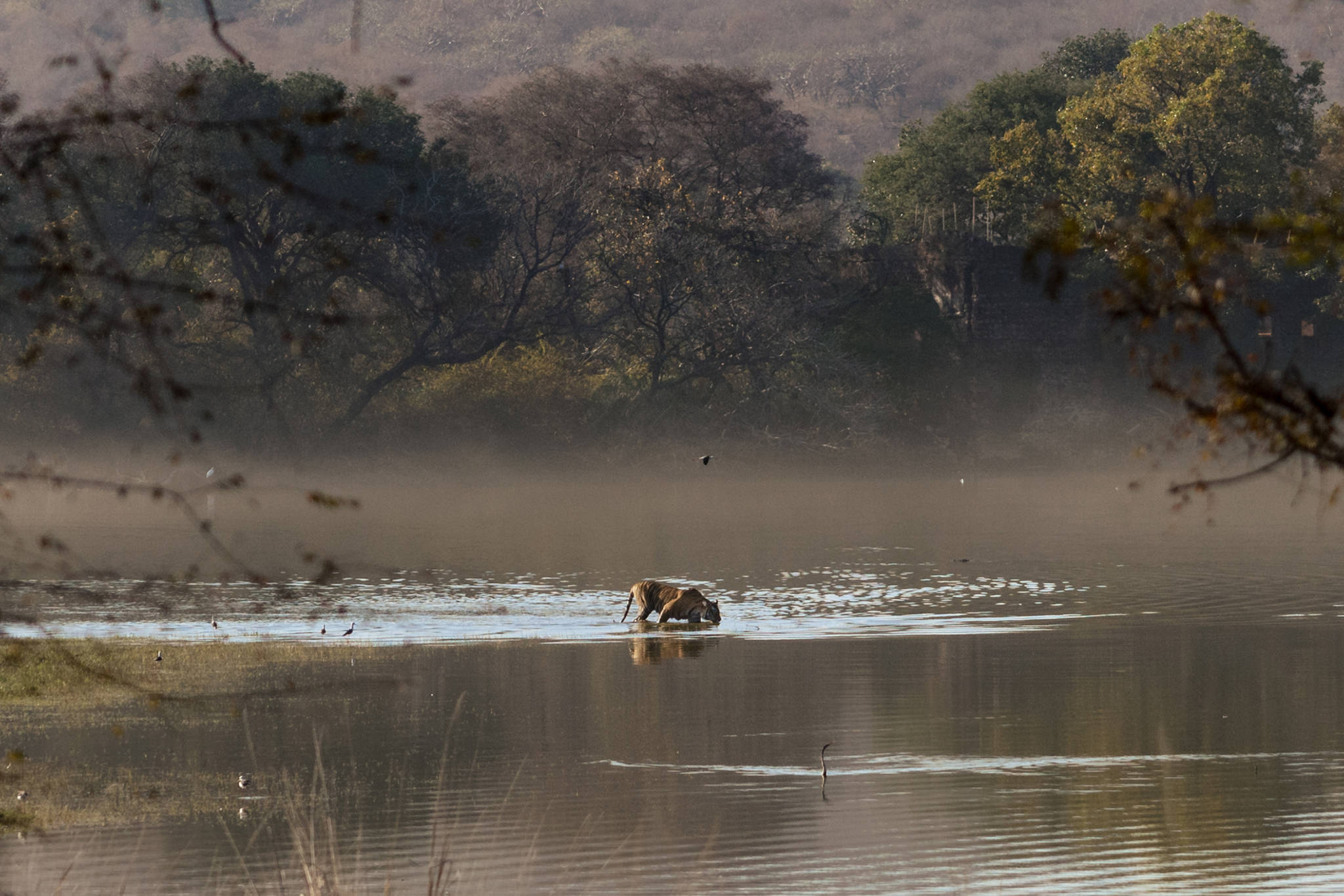
When she arrived in the tall grass by the lake, things got extraordinarily loud quite unexpectedly: she’d reunited with her sub-adult female cub, who was already concealed in the grass, and neither of them sounded happy to see the other. Added to this excitement was another loud call that we thought came from just across the lake, but our guide said it was a different call from the pair in the grass. We listened to them fight for several minutes before they declared a truce; just as they settled into snoring, we realized another tiger was stalking across the water. It appears that we’d found the source of that other roar.
I’ll point out that they did this all in rather beautiful dawn light (except for the fighting, which we couldn’t see). My photographer heart was as happy as their snoring was loud.
Our guide recognised the interloper as one of Riddhi’s male sub-adult cubs. We watched as he crept through the shallow water, eventually stopping on the shoreline just out of reach of his two snoozing family members. Tigers are nocturnal animals, so our guide knew that naptime would like last for quite awhile. We’d been with Riddhi for just under two hours by this point, so he suggested that we go for a drive to see some other parts of the zone and check back in on them later. Let’s be real: he could’ve showed us the backside of his hand for an hour and I don’t think anyone would’ve cared. While I think it’s important to be able to appreciate a variety of animal sightings on game drives instead of focusing on one main predator, when you find THREE of a park’s main predator in the first hour, your guests aren’t going to be too concerned with what else they see.
With tigers in the area, the deer population had made themselves scarce, so the rest of the drive was spent spotting crocodiles, a small variety of birds, and a lone mongoose – and I don’t think a single person minded the absence of biodiversity that morning. We disembarked in the hot parking lot with big smiles, ready to go back to the hotel for breakfast and a nap while I made sure my batteries were charged and ready for the afternoon.
Our afternoon Zone 1 drive showed us just how lucky we were that morning: there was one brief sighting by one vehicle in our zone, but otherwise all vehicles returned without any major sightings. Knowing that the deer clear out when there’s a tiger in the area and can take up to three hours to return, it was disheartening to see what felt like a record number of sambar and white spotted deer seemingly everywhere we went, but I did at least find humour in it. That’s the way it goes with safari – sometimes you’re lucky, and sometimes you’re not!
That evening, we ate heartily and asked for as much heat in our dishes as we could, which was the sign we both needed that we were back on track.
We still hadn’t received a confirmation text for our waitlisted tickets to Agra, so we were feeling a little anxious by the time we were heading to the train station the next morning. A visit to the ticket counter resulted in the agent telling us to get on the train anyway. Did I hear that correctly? Not sure, but rolling with it because it was going to get us to where we needed to be!
We proceeded to the correct platform, got on the train, and found out that yes, this is actually commonplace – we weren’t risking being stowaways. We shared the carriage attendants’ bench and two of them crawled into the stowage space to make room for us. I felt claustrophobic on their behalf but reminded myself that the train route lasted 2.5 days, so it wouldn’t surprise me if they work in shifts and have to find ways to sleep in between. The conductor eventually came and found us: we had a berth.
I detailed our misadventures with another train passenger on Instagram, but the short version is that we had a cabinmate who felt entitled to use any berth he wanted while belching and scratching himself in my face, which was every bit as delightful as you might imagine. When I eventually spoke up and made him share space according to the rules of Indian train travel, he didn’t take especially kindly to this. Another passenger spoke up and intervened, at which point he backed off. After so many hours on the train, it’s still impressive that this is the only negative encounter that we’ve had.
Our Agra arrival was unceremonious, but our arrival at the hotel certainly impressed. In the name of research, we were booked in at ITC Mughal, one of Agra’s midrange 5* hotels. After a quick walk to stretch my legs and eat some seriously spicy noodles and momos (the chef actually came out to see me because he seemed to not believe that a foreigner wanted to eat spicy food), I “researched” my way into bed quite happily. The alarm was set for 5:10am: the Taj Mahal awaited.
5:10am is early. Man. But when you’re going to have the chance to photograph one of the world’s most recognizable landmarks in dawn light, you get a little extra speed in your step. We climbed into the car at 5:30 for the short drive to the West Gate, where we could walk to the admission point.
It’s amazing how a place can go from quiet to heaving in the space of 10mins, but that’s what we saw happen as we waited for the ticket scanners to get started. The surge of people through the barriers was fascinating, and the rush that some guides made to get to “the” spot (17 times) was a little disheartening. It’s clear that there’s a pattern to how visits usually go at the Taj.
Thankfully, ours didn’t follow most of that pattern. Our guide, Jolly, was a gentle-spirited man who had a profoundly romantic appreciation for the Taj. He spoke of the building like one would a good friend, and I loved the way he seemed to marvel at each detail. In Jaipur, it often seemed that we were told how to feel about each site we visited, but Jolly simply shared details that he found fascinating and let us decide on our own favourite details. He took us to a few of the classic spots for photos, then broke from the standard flow of tourists and went in the opposite direction so that we could appreciate the way the building changed colour as the sun rose. I was completely taken by the fact that every time we looked up, the white marble seemed to be tinted a slightly different hue.
I hadn’t been sure what to expect of a visit to the Taj Mahal. I was going largely because it seemed to be one of those things you have to do while in India, but it only took moments for me to realise how unexpectedly enchanting it was. Yes, there were swarms of people. But there were also peaceful pockets where we were entirely alone. It was challenging to make photos of something that is so incredibly frequently photographed (often from the same angles and with the same intent), but as we settled into the space, I let my mind wander and, gradually, some different photos took shape. I think I could’ve likely spent an extra couple of hours just watching the play of light and shadows as the sun shifted. I laughed when taking one more photo on our way out as a hand stretched into my frame with a phone – and then took the photo anyway because that’s the real nature of a visit to the Taj Mahal.
We got back from our tour in time for what was honestly a magnificent breakfast. Rich practically cartwheeled when he spotted a tray of bacon, and I attempted to eat my body weight in fruit while over-caffeinating myself on some lovely masala chai. After completely overindulging, we spent the morning taking advantage of treadmills and the pool, then met up with my company host for a couple of site visits that Rich was thoughtfully included in. The upper-tier 5-star hotel in Agra is really a sight to see, so it was fun that Rich got to join in.
I’d had plans to go explore some of Agra that evening, but we were beat after a full day and had yet another early alarm, so decided to have a couple of hotel cocktails and call it a day, with our alarm set for 4:30.
It was hard to believe that our last stop was upon us.
Grateful for: a shared sense of wonder