
As ever, supporting photos for this post can be found on my Instagram account.
The road from Gaziantep led to Cappadocia, a city we were visiting with high hopes and a certain amount of trepidation. Would it live up to expectations? Would it be a tourist hellhole?
But first: ice cream. We’d learned that Turkish ice cream or dondurma originates in Kahramanmaraş, which was on our way to the famed home of Türkiye’s fairy chimneys.
We stopped at a place owned by an usta (master) named Ibrahaim; a gentle soul with a demeanour as sweet as his product. Unusually, Rich and I both opted for the same flavour combo: natural, so we could see what dondurma tastes like in its simplest form, and black mulberry because it was in season. Ibrahim quietly served up our bowls and artfully topped them with a little sprinkle of pistachios before handing them over with a giant grin. The flavour was absolutely incredible – and only made better by the fact that it wasn’t yet 11am (having the free will to choose treats for breakfast is peak adulthood, as far as I’m concerned). Mulberry has a tart flavour reminiscent of a combination of cranberry and blackberry, and the natural scoop offered lightly sweetness that balanced the mulberry tang. I found it so fascinating to see how this version of ice cream has a certain stretchiness to it, courtesy of the salep and mastic used as part of the recipe. If you could take that last little lingering stretch of saltwater taffy and chill it, you’d come fairly close to replicating the texture of dondurma.
We made one more stop on our way to the rocks because we were passing another city renowned for a particular dish and couldn’t pass it up. Kayseri, in the central Anatolian highlands, is the home of manti – Turkish dumplings. These tasty morsels come in a variety of shapes and sizes but are based around a filling of spiced meat (beef or lamb) or potato wrapped in thin dough; the parcels are then boiled and served with a thin sauce and garlicky yogurt. Reminiscent of Polish pierogi, Chinese jiaozi or Tibetan momos, they’re a stark reminder of how cuisine moved between cities within the Ottoman territory. Traditionally, a Turkish bride is judged on her ability to form her manti as small as possible, with the goal being to fit 40 on a single spoon. We ordered a couple of plates and tucked in to our larger, momo-style potato manti. The serving style is unusual for Western palates: they’re heated, but served under cold yogurt, making for a lukewarm lunch. We loved the dumplings, but found the yogurt too heavy a blanket for the manti to successfully stand beneath. Perhaps they’d be better with a drizzle rather than a deluge of yogurt. Still, they were worth trying and added another jewel to our Ottoman culinary crown.
Off we zipped to Cappadocia.
I was terrified that Cappadocia was going to be overrun with fellow tourists and that the result would be a pretty landscape overshadowed by the effects of mass tourism. While we’d come to learn that Göreme, the region’s main tourist hub, is very definitely reflecting the toll of increased tourism, I discovered my worries were otherwise unfounded. Within 20 minutes of arriving in the area, I was practically skipping around our remote parking spot while looking out at incredible views across the valley. Within two hours, we’d agreed that it was one of the coolest places we’d ever been.
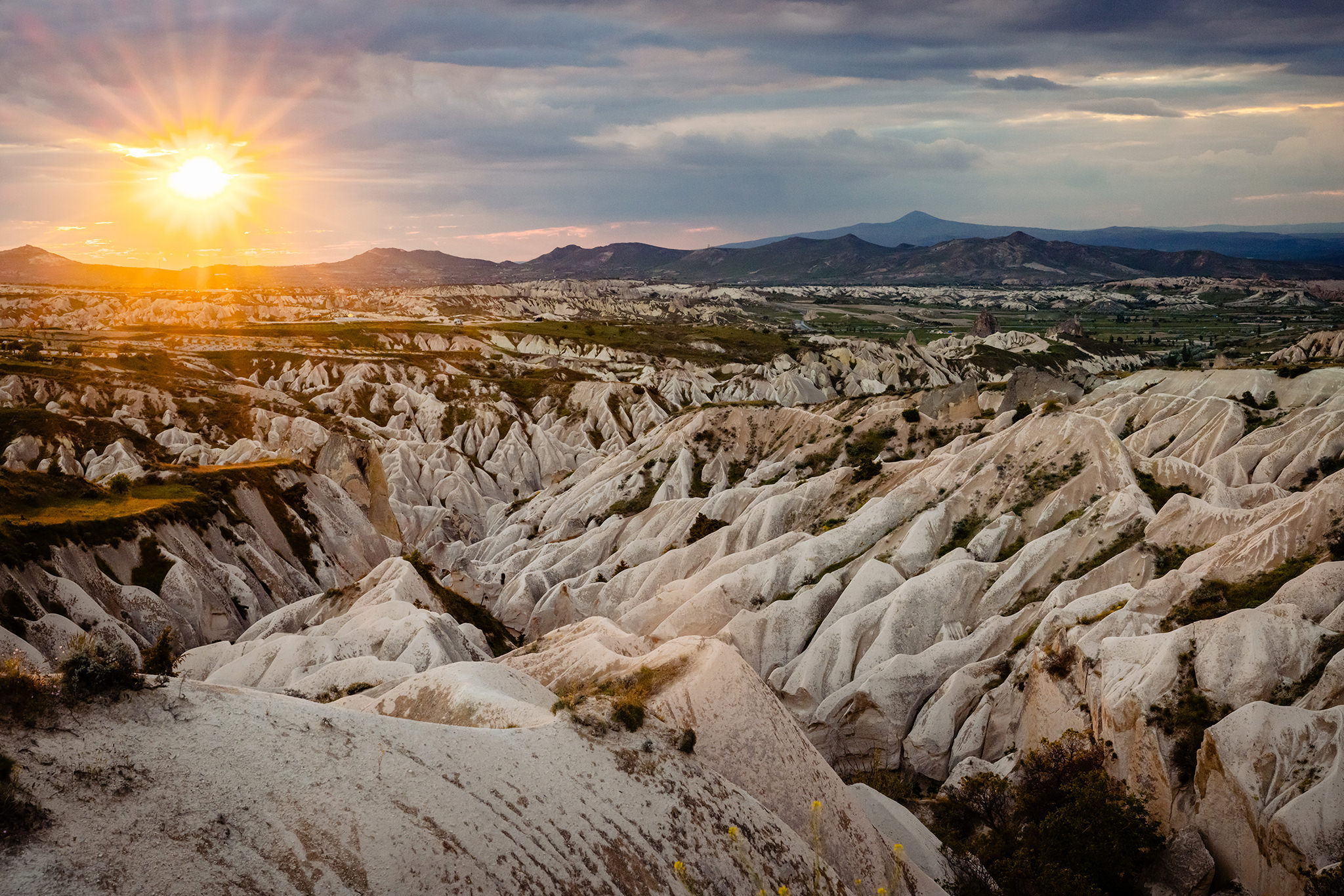
Cappadocia’s claim to fame is its fairy chimneys: pillars and mounds and rippling ridgelines that have been formed over thousands of years as the porous tuff (hardened volcanic ash) eroded while the basalt top layer created a form of natural umbrella, creating these towers of rock. Since the under-layers are comparatively soft, it’s possible to sculpt them and locals began carving cave homes, churches and, later, hotels into the bases. Due to a rising housing crisis in the region, many cave homes are now being reclaimed by Turks.
On our first evening, we started to gain a basic understanding of the topography. We clambered down into one gully to do a bit of exploring and marvel at the abandoned cave homes that we found before climbing back up to the car to enjoy a little picnic in the car as the sun set over Red Valley. As the sky darkened, we made our way to Villa Comfort, which is brand new and has a glorious shower (coming from someone who hasn’t enjoyed many hot or high-powered showers of late).
We set our alarm for 4:40 the following morning and hightailed it out to a spot that we thought would be great for watching Cappadocia’s famous sunrise hot air balloon flights, only to figure out that wind speeds meant the day’s flights had been cancelled. We slunk back to bed and crashed out, feeling badly in need of some extra sleep, then enjoyed the hotel’s massive Turkish breakfast spread before heading out for a day of hiking.
While Cappadocia is most famous for its hot air balloons, it also has some incredible hiking trails that wind in amongst the fairy chimneys, and I would say that if you leave without exploring at least a couple of the trails, then you’ve done yourself a major disservice.
Red Valley and Rose Valley took us along 10kms of trails that wound through vast valleys that effectively highlighted the variety of landscapes in the region. We wandered between towering pillars that dwarfed us in scale. We nosed our way through smaller cave homes that were long since abandoned. Climbing up stone staircases that sometimes left us scrambling on all fours, it was never easy to guess the scale of what was waiting inside the next cave. Often it led to a series of small rooms that made up a simple home, but we also found ourselves gawping at one church with an intricately carved ceiling as well as a miniature cathedral with an elaborate vaulted ceiling, ornate ivory columns and sleek arched doorways, all sculpted – not constructed – out of a single mound of ancient rock.
Sometimes we marvelled, other times there was nothing we could do but laugh. While hiking Rose and Red Valleys, we made our way through one valley filled with giant, bulbous hoodoos that looked like a collection of butt plugs. After we finished that hike, we drove over to hike Love Valley, only to discover that it got its name because of the phallic shape of the pillars located there. Love Valley is a short hike and made for the perfect finish to a half-day of hiking. It’s comparatively narrow, in opposition to Rose and Red Valleys’ expansive terrain, and only gets narrower as you hike further, until you eventually run out of valley. There’s a poorly-marked option to make a steep climb up and out past a conveniently located tea shop with gorgeous views back down the valley, or you just retrace your steps until you’re back at the mouth of the valley. AllTrails, while far from my favourite hiking companion, actually has pretty reliable routes through the valleys and my advice is to simply pick something and go – you’ll have a memorable walk no matter what choice you make.
As we worked our way along the trails, we marvelled at how much time we spent alone. In 15kms of hiking that lasted 4.5 hours at one of Türkiye’s biggest tourist draws, we crossed paths with perhaps a couple of dozen people. Not that I was complaining, but where was everyone?! (Not to worry: we found them all when we drove into Göreme….) We were there in mid-May, which counts as main tourism season in the country, so it was fascinating to discover that it was possible to feel like you had any place to yourself. If I had to do it all again, I would likely take an extra day and trail run the same routes that we hiked. As it was, I stopped so often for photos that the hike was extraordinarily gentle for us – and I regret no part of that.
In a day filled with seemingly unbelievable details, perhaps the biggest marvel was the fact that we didn’t pay a penny for access to the hikes or parking. I’m not sure how sustainable it is for a region to be inundated with vehicle, foot and bicycle traffic, yet not be charging national park fees (because you are in a national park when you’re there), but we felt fortunate to be able to experience it while it was both quiet AND free.
Our choice of dinner in Goreme was Pal’s and it included a rarely-found glass of wine (what a treat!), but our most expensive Turkish meal to date also ended up being the most mediocre. Rich struggled through rubber bullets disguised under the name of “chicken kofte” and my second attempt at manti made me conclude that I love the idea of the dish more than the actual recipe itself. They just get too cold too fast under that milky sea of yogurt. It was a shame for the food to be a letdown, since the owner was lovely and we had a great time joking with him – in English, no less! Pal told us that, because he was the waiter and the dishwasher and he was very tired, we weren’t allowed to leave until we finished all of the sauce that came with my manti – and then even went to get us more bread with which to mop up the juices. It felt novel to be able to converse quite freely in English for the first time in weeks. We headed to bed smiling through the sting of the bill, wishing we’d been able to continue our string of incredible meals.
A 4:20am alarm. A silent prayer for low winds. A race to reach a spot we’d scoped out the previous day during our explorations. Bursts of flame in the distance and the first balloons prepared to rise. An abandoned plan and a new choice, courtesy of a change in wind direction, followed by a frantic leap from the car and a race to the cliff edge.
Our morning started with a frenzy of activity and squeals of excitement (mostly from Rich, I swear). By 4:55am, the first balloons were lifting off against the backdrop of pink sky, Göreme’s glowing lights and the blue shadows of dawn. The aerial parade was still going at 6:35am, as the city lights switched off and the rays of the sun changed the hue of ancient stone from hazy blue to brilliant gold. I knew there were an unbelievable number of companies to choose from in town, but when I counted 66 balloons during the early stage of the first of two waves of departure, it became apparent that there were hundreds of balloons. I come from a city that used to host a gorgeous hot air balloon festival, but the scale of this balloon industry absolutely dwarfed anything I’d ever seen before. Some balloons flew so close to us that we could easily read facial expressions and could’ve thrown a ball to the occupants – in fact, a little jog down one hil and we would’ve just about been able to pass them a cup of coffee.
The downside of the amount of tourism in Cappadocia is that the growing daylight also highlighted the number of Instagram photoshoots that were happening on the cliff edges with balloons in the backdrop. We even saw one place that had a full-blown proposal setup, with the big question spelled out on the ground. The detail that really got my eyebrows lifting was that it appeared to be a permanent setup, not one that was done for just one couple. While our engagement story falls on the opposite (and embarrassing) end of the uniqueness scale, I’m positive I’d have been particularly unimpressed if Rich’s proposal had included something so manufactured.
As the first wave of balloons began to descend just behind where we stood, we decided it was time to make our move onward towards the south coast. We made our way back along the cliffs and climbed in the car, preparing for the long drive ahead, but not before we got stuck in a small traffic jam and watched in awe as some highly-skilled pilots managed to land their balloons directly on their trailers.
I’m not sure that we’ve ever left a city feeling so thoroughly like we’d revelled in all of its magic before. Cappadocia, you’re a gem – even if you’re full of tourists.
Grateful for: goosebumps