Upon our departure from Chefchaouen, I was hurting, my knee was a mess, I was slowly coming to the realization that I was going to have to debride it myself, and I was overtired (and a real joy to be around, I’m sure).
The drive was relatively short – just 3.5 hours – and we were really just looking to get it done, but we got pulled over by the police not long after we’d started and told we’d had a speeding infraction. I was miffed. We’d passed multiple traffic stops on our way out of Casablanca and knew that speed patrols were common. When the officer mentioned a second infraction, though, I began to feel a little doubtful. He informed Rich that he could pay the speeding fine on-site and the rest would go away. Allll the red flags. But Rich handed over the cash, which was about 30% of our day’s budget, we pulled away (slowly), and I tried to move on.
But when the second traffic stop happened – we were told it was because we hadn’t come to a complete stop at the checkpoint – and the officer began talking about paying the fine in cash, Rich could only look on in horror as the full extent of the loss of control I was experiencing resulted in a full meltdown as though someone had lit a fire right there in the front seat. Through my tears, I raged at the unsuspecting officer about his colleagues demanding bribes on the side of the highway. It was probably the worst place I’d been in, both physically and emotionally, during any trip of my life, and my frustration over the current predicament flooded out the vehicle and momentarily robbed us all of air.
Clearly unsure of what to do with my tears (and, being an extremely patriarchal country, likely judging Rich for not having better control of his wife), the officer disappeared with Rich’s documents and dirhams for several minutes before returning, handing back the money we’d given him for the fine, checked to make sure I had water, and told me to smile – it would be okay. If there’s one thing you should probably never do to me it’s tell me to smile, but I gritted my teeth and we exited the situation while I tried to see if my dignity was hiding under my seat.
It’s almost comical to know, in hindsight, that he was the one looking for a bribe. The sign beside his checkpoint read, “slow.”
We were back on the road to Fes.
Fes is known for being Morocco’s first city and also holds the record for being the world’s largest medieval medina and car-free urban area. Its medina contains close to 10,000 lanes and alleys, all filled with history, not to mention countless market stalls at which to browse (though not helpful when you still have 3.5 months of travel ahead of you).
Just because it’s car-free, doesn’t mean it’s chaos-free. Bikes, carts, donkeys, motorcycles, large groups of tourists senselessly blocking the lanes, vendors hawking their wares – it boasted a lower decibel level than Jodhpur but somehow managed to be more overwhelming and in your face. Every step felt like we risked losing a toe to passing traffic or our sanity to yet another human blockade or a request to come look at a shop.
When you’re in a city with high walls, Google Maps gives up on you and you’re left to go with God (or Allah – choose as you will). Even Rich was initially discombobulated by the alleys and dead ends, many of which don’t appear or are inaccurately represented on Google Maps. Gradually, though, we (like how I pretend I’m in on this orientation mission??) began to learn our way around using landmarks: Dead Cat Corner (which, thankfully, didn’t end up involving dead cats, though the kittens’ chances of survival seemed questionable when we first saw them), our friendly neighbourhood hash dealer who would drop orders down from the window using a small pail on a string and bring his baby to the window to the window to wave hello to me, the loquat vendor in the market, the mosque with the magical light that filtered through gaps in the rooflines to hit the front door, our medina gate, the park with the towering row of palm trees.
One of the many advantages of travelling with Rich is that once he gets his bearings – which happens far faster than makes any logical sense – he’s eerily accurate with his navigation. In Moroccan medinas, this means is that we get to confidently say “no thank you” when “guides” offer to help us (for which there will inevitably be a fee requested). Unfortunately, we didn’t say it firmly enough on the morning we headed to the tanneries, so we had the human equivalent of a deer fly following us and trying to tell us where we should be going the whole time we navigated to the shop we wanted to go to. Rather awkwardly, we discovered this was also the same shop he wanted us to go to, leaving it looking like his assistance had been needed. When we’d finished, Rich conceded an overgenerous amount to the baksheesh (tip) because he’d had enough, and our “friend” disappeared as though teleported. This sort of predatory behaviour is frustrating, but also a reminder that self-advocacy and assertion are necessary when travelling. Did it cost us much? Not at all, but it did reinforce the behaviour.
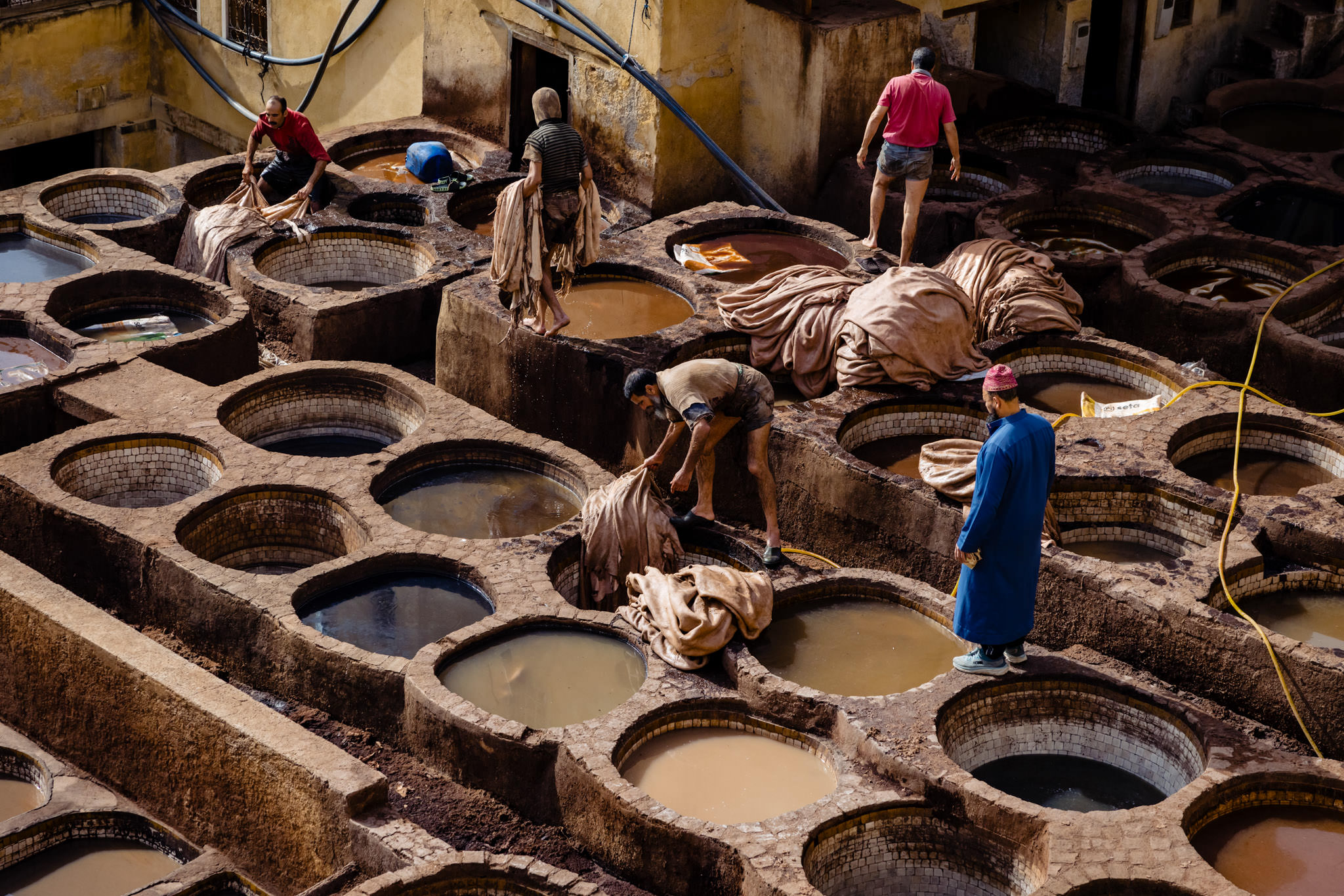
Fes’s leather tanneries are one of its must-see details and Chouara Tannery is the best option. Yes, you’ll have to deal with some gentle pressure to buy some goods from one of the shops that have terraces overlooking the tannery pools or leave a tip equivalent to a couple dollars if you don’t buy anything, but it’s worth it. The city’s tanners still use traditional methods and ingredients (including urine and pigeon feces – with no sense of smell, I really came out of this one as a winner!) and the shops give you an emperor’s view over the whole process, from the removal of flesh from the hides to drying to movement of hides between different pools. Rich was slightly aghast to see men dumping lye into pools with absolutely no skin or eye protection, but was relieved that they booted up when it was time to stand on the hides in the pool. Something tells me workplace health and safety isn’t at the forefront of the operation…
Along the way, we also realised that the pattern of prolonged conversation with shopkeepers prior to them getting to the point isn’t a sales tactic: it’s their culture. Moroccan greeting are prolonged and tend to cover enquiries about the wellbeing of the other person’s family – seeming going back seven generations, if the conversation length is anything to go by. After the burgeoning sense of mistrust that we’d had building courtesy of the scams in Istanbul and the police stops en route to Fes, it felt enlightening to realise that this is why it feels like vendors are going for the soft sell for the first five minutes of conversation. It also made me feel like I understood them a whole lot better and could approach each new situation with a little more patience.
In spite of being the sensorial equivalent to living inside a tuba performing in a marching band, there’s also – ironically – a quiet rhythm to it, which takes time to recognise. You have to do “the usual” (Bab Bou Jeloud, Medersa Bou Inania, Al Attarine Madrasa) before the other details start to become evident: the way the light filters through the overlapping rooftops and illuminates one little pocket of Medina detail at a time; the unbelievable amount of detail in the tile work and door carvings; the ornate ceiling lights; the little nods from shopkeepers savvy enough to know we weren’t their target market. We watched coppersmiths at work in Souk Seffarine, hammering and polishing their wares; and marvelled at the true nose-to-tail consumption that obviously happens, given the displays on and suspended above the butchers’ counters (where I noticed testicles always seemed to take pride of place, but I even spotted a bin containing udders!). We tried deliciously refreshing orange salad for the first time and began rating the tea shops on our own system of price, bitterness, and bonus inclusions. Two young shopkeepers struck up conversation “just because”, then asked for photos – and it was fun to see their faces when I was able to transfer them off my camera and get them sent via WhatsApp in the space of two minutes while we chatted. We watched as golden light heralded a cue to the swallows to go on their dinner time hunt, swooping in and out of their nests built into the city walls, which have nooks for exactly this purpose. After a couple of days in the city, the overwhelm had started to fade enough for us to appreciate these sorts of details.
If Fes is the big, brash older sibling with Daddy issues, Meknes is its softer, quieter, and calmer sibling – the one who was left to get on with things and did so with perfect competence. The markets offer household goods for everyday life rather than stall after stall of “genuine fake” goods mass-produced anywhere but Morocco. Vendors know you’ll ask if you need something; they’ve got better things to do than harangue you for sales. We had a good wander through town, soaking in the details of its stunning mausoleum, relishing the peaceful atmosphere and wolfing down a couple of mixed grill sandwiches that were so inexpensive we had to double check the price. It’s a place that makes it easy to just “be” and served as good practise for Rich, who often feels the need to “do.”
Prior to choosing a base in Fes, we had debated which city best matched our style and struggled to feel confident with our decision to choose Fes. In hindsight, I think we made the right choice, not because we liked Fes better (we didn’t), but because Fes would’ve felt wildly offensive and even more overwhelming if we’d only had a day there. As it was, a day trip to Meknes offered us respite from the chaos and gave us even more appreciation for the peaceful oasis that it is.
As we prepared to head south, my knee was finally beginning to look like it might be making progress in the right direction towards healing (or was, at least, producing fewer green bandages!) and we each quietly acknowledged that we felt perhaps more exhausted by Fes’s tumult than either of us had anticipated. We relished the idea of having time by the sea to slow down.
Grateful for: gauze