
Accompanying photos can be found here.
From Çamlıhemşin we drove five hours to Erzurum. We had originally planned to stay two nights but along the way decided we’d also like to carry on down the road to Mardin afterwards, so we made the most of a single night in town.
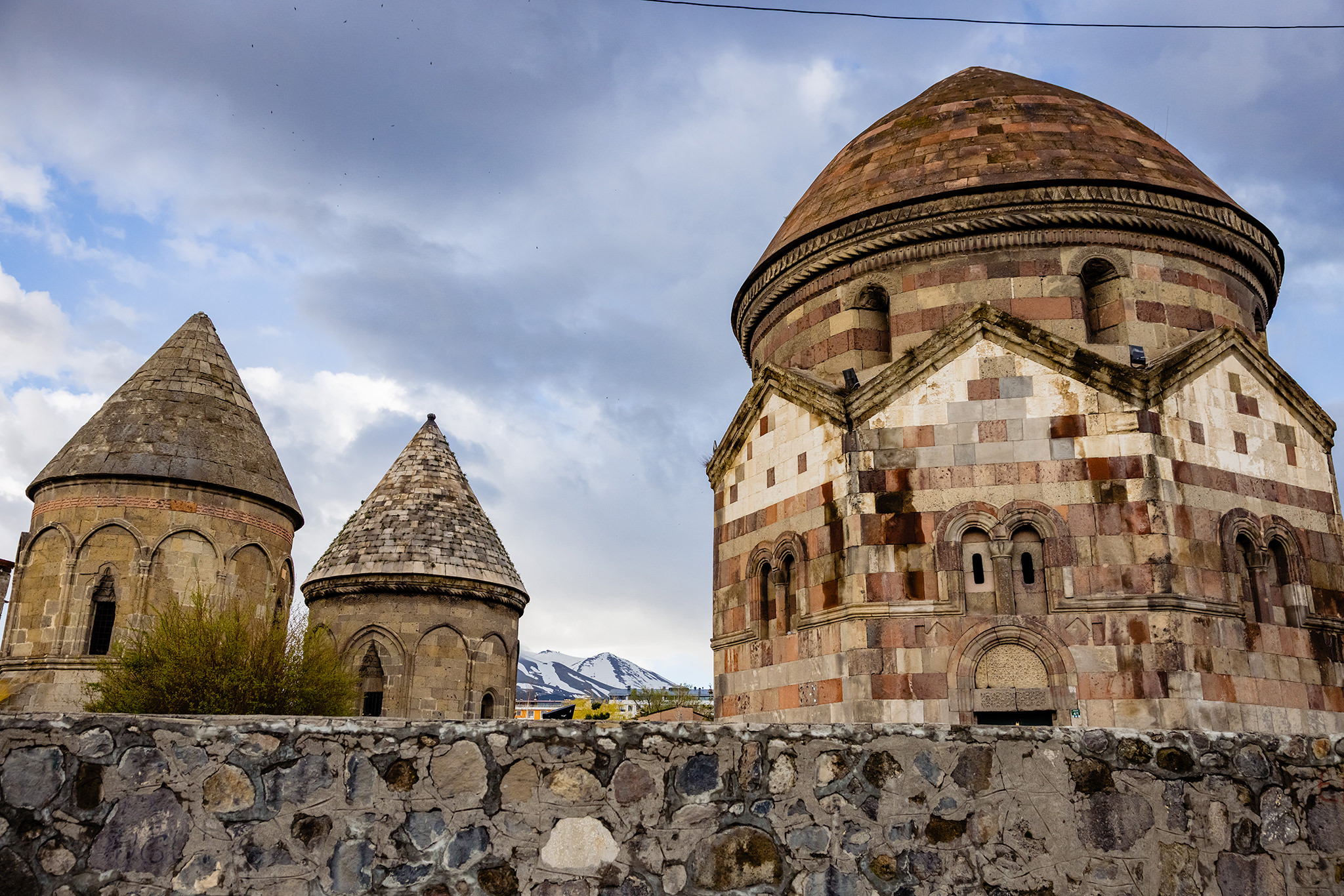
Erzurum is, unfortunately, a pretty bland town – our new plan was for the best, it seemed. The city has some charming old houses and three old tombs downtown, which we felt obliged to ogle in the absence of anything else to do besides enjoying several rounds of tea at a cute little teashed.
The main reason for visiting the city was to taste its cağ kebabı (“jai kebab”), for which it is famous. Cağ kebabı is made by stacking marinated lamb rib and leg meat onto huge skewers and then slow roasting them, horizontally instead of the typical vertical orientation. When ordering, the meat is then thinly sliced and put onto small skewers, which are heated over the coals. You purchase a particular number of skewers, which you can’t help but devour quickly and, if you’re smart, the skewers are then put in the cup on the table. If you’re like us, though, you sit and stare at said cup and wonder if that’s where they put your bill. Whoops.
One night in Erzurum and we were zooming off to Mardin, reputed as the country’s prettiest city. We’d come to learn that there isn’t a lot of competition for those particular bragging rights; however, Mardin has rightfully earned the title. If you ever tell a Turkish person that you’ve been to Mardin, they will always respond with a contented sigh of acknowledgement – it’s clearly a place of which they’re quite proud. If you told me we’d arrived in Puglia, I would’ve believed you without question: white and pale blonde sandstone was everywhere. So were the stairs, which were lots of fun when loaded with our backpacks.
We checked into our hotel, where we were led down a short staircase into our room, which was distinctly reminiscent of a sarcophagus, and later met Bumpy, a dress-wearing Pomeranian with an attitude problem (maybe because of the dress).
Mardin is a series of winding, hilly alleyways and one long main street filled with restaurants, cafes, wine shops and souvenir stores. The main square is lovely, but oddly (and frustratingly) unphotogenic because of the visual clutter surrounding it.
My near-constant interest in snacks meant we sought out a falafel shop that I’d read about and that’s where we learned a small cultural lesson about Türkiye. The shop wasn’t closed, but there was no one there. Seeing us hesitate at the doorway, an ice cream shop owner across the road, signalled to us that we should sit down and wait. He made it clear that the owner would be back momentarily and we slowly realised that the owner must be at prayer. When the falafel shop owner returned, he greeted us with a shy smile and a warm welcome; through halting exchanges about his incredible falafel and hummus, which were both some of the best I’ve ever had, I came to learn that he was Syrian. The border is practically visible from the town’s hilltop, leaving me to sit and reflect for a moment on what life must’ve been like in Mardin at the height of the war and resulting refugee crisis. It’s little wonder that the shop owners look out for one another.
I got carried away with my enthusiasm and bought extra food to take with me, but was left shaking my head in wonder when our bill came to a grand total of $10 for an astounding amount of food.
It turns out that a 3pm falafel feast isn’t great for encouraging an evening appetite, so Rich was the only one looking for dinner after we’d done a couple laps of the main drag. He enjoyed a great kebab while I enjoyed some roadside people watching and we marvelled a the sheer volume of tourists, both domestic and foreign, that move through the town.
Next stop: Gaziantep, the culinary jewel in Türkiye’s elaborately decorated crown
Grateful for: moments of reflection