
As ever, you can head over to my Instagram account for a look at our time in the city.
Prior to visiting Gaziantep, Türkiye had been proving itself to be filled with natural beauty, some incredibly warm people, and many characters who required you to always have your guard up. While we were already enamoured with the food, its cities gave us all the warm fuzzies of a cactus. The problem we keep running into is that the country’s cities are almost always uglier than a baboon’s asshole courtesy of communist-era architecture and oversized signage.
Gaziantep would be its redemption.
We stayed in an apartment that was located well outside the tourist centre and only a block away from a massive park that proved to be excellent for some long runs – loads of shade, interesting sculptures, and enough length that I only had to double back on a small portion to reach my double-digit target. Our apartment was also surrounded by incredible local restaurants with reviews almost entirely by Turkish nationals (ie people who know what they’re talking about). We stayed for three nights, but could’ve happily slurped and munched our way through the restaurant options for another two days without issue.
Classified as a UNESCO Creative City of Gastronomy, Gaziantep is synonymous with excellent cuisine in the eyes of any Turkish person but is relatively off the radar for most foreign tourists, which made us something of a novelty in the city. We had many encounters with locals who wanted to know why we were visiting Gaziantep, and our response was always simple: “To eat!” This was usually met with both surprise and joy, immediately followed by questions about what food we had tried so far. We were quickly learning that if you want to connect with a Turkish person, just start talking with them about Turkish food. You’ll become family in the space of about four sentences.
Our first stop in the city was a place called KaburgAntep, a tiny spot where the owner seems to work every position, alongside his staff. We’d heard that visiting Gaziantep means trying the lamb (our favourite!), so we tucked into an assortment that we ordered with some help from our new friend (and Google Translate): ribeye, fillet and ribs (or kaburga in Turkish). All were incredible. We ended up visiting twice while we were in town and, after our second meal, the owner invited us to come back the following day to visit – quickly adding that he didn’t even care if we came to eat – because he was just keen to welcome us to Gaziantep. We couldn’t accept the offer because we were leaving for the south coast, but the invitation was touching. The most remarkable part of this whole exchange was that he’d managed to make us feel so valued entirely through a translation app. We didn’t know if yet, but this urge to make newcomers feel welcome despite a language barrier would become an ongoing theme.
Yesemek won us over on our very first morning and we crowned them the home of the best beyran, a spicy soup made of slow-cooked lamb neck and rice that takes “stick to your ribs” cooking to a whole new level. Not only is their lamb the requisite level of blow-your-mind tender, but their stock is brimming with chili, providing heat that blooms rather than explodes over your tastebuds, and their lemon wedges are served with adorably practical little shower caps. As we sat in the pool of early morning sunshine flooding through the restaurant’s front window and took our first bites of Yesemek’s rich and profoundly flavourful soup, I understood why it’s commonly eaten at breakfast by sheep farmers in the mountains who don’t bring lunch out to the high pastures.
Kelebek became another favourite spot. Their well-armed kitchen brigade slings hundreds of bowls of paça (a local favourite: lamb’s head soup) and beyran alongside platters of juicy kebabs. Our mixed kebab platter and eggplant köfte kebab plate came with so many sides that we were reduced to bursts of giggling with our server as he played culinary Tetris – our little table for two couldn’t hold all the food. This place sees so many people for any given meal that service is typically pretty brusque, but staff were so curious about the foreigners that I ended up getting a kitchen tour to look inside the lamb stock pots so large I could’ve bathed in them then a walk-through of the assembly line for paça. The whole team nodded enthusiastically as I mimed my questions about the provenance of the pot contents and the happily showed me the skulls and the rest of the components – eyeballs and all.
Gaziantep has a lovely Old Town and, much like Mardin, seems to be beloved by domestic tourists. We wandered the alleys, passing shopfronts overflowing with spices, ground chili in 14 different forms, plus the usual assortment of knick-knacks, lokum, baklava and tea. I happily snagged a few different types of Urfa biber, one of my favourite kinds of ground chili that carries rich, smokey notes of chocolate and dried fruit. Courtesy of a lack of understanding what 200g of chili looks like and an irrepressible need to buy things when I finally find good prices, I now have enough to last me until I’m approximately 143 years old. Maybe I’ll put my supply in my will.
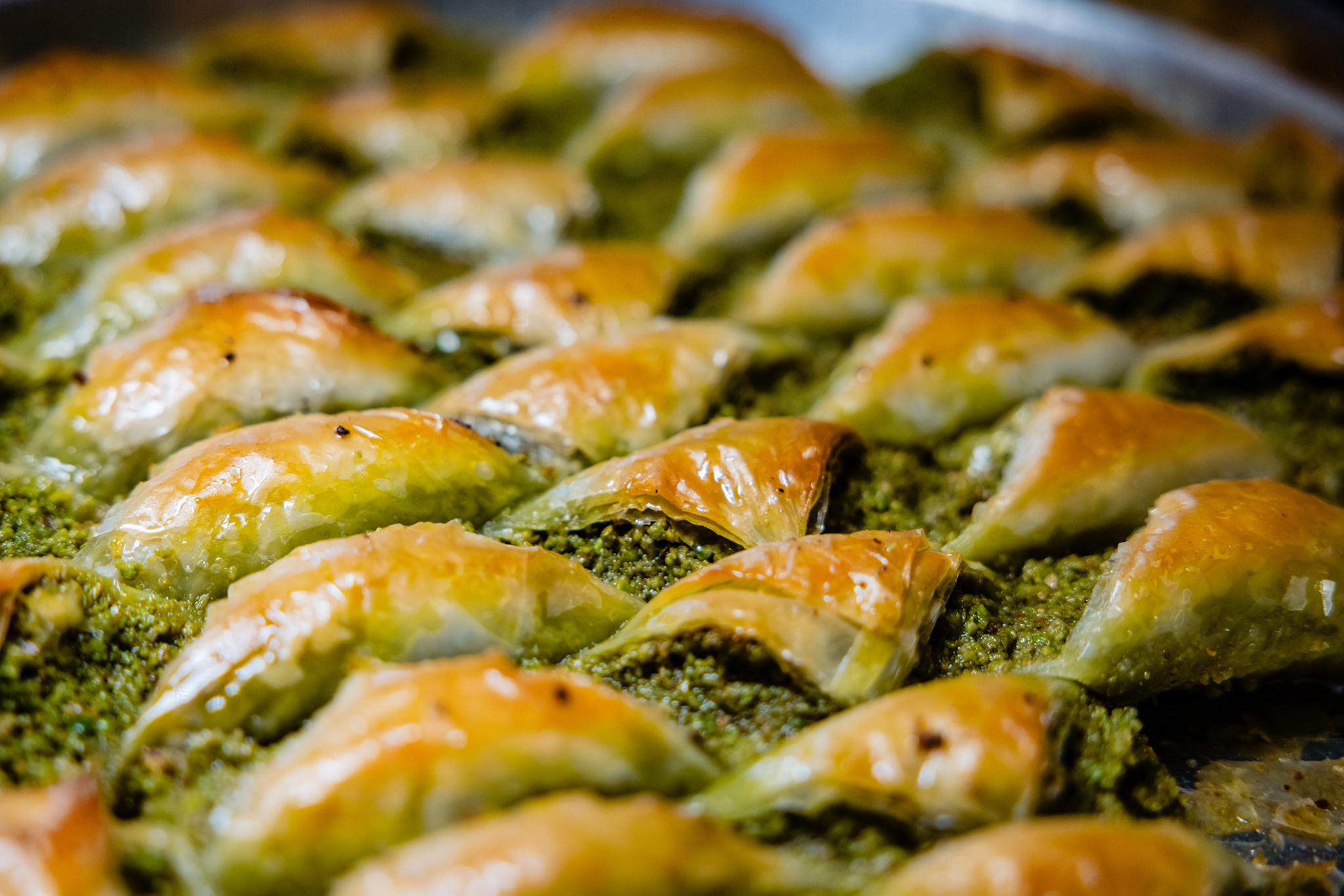
As part of our meandering, we also detoured past a particular baklava shop because of insanely high reviews and I bought a few pieces that almost caused me to choke over the price. The kid running the shop welcomed me behind the counter to take photos of the gorgeous display case brimming with gold-and-emerald edible artwork and even broke out a little LED light! Clearly not new at this… We walked away with our treat, quietly wondering if it was platinum-plated, but no – just loaded with Antep pistachios. Or so I thought. Tucking into a piece a short while later, I found myself entirely confused and uttering something I never thought I’d say while eating baklava: “Why do I taste cheese?” It turns out that it was a mix of semolina and kaymak (a form of clotted cream), not cheese, although the end result felt the same to my uninitiated tastebuds.
As we headed into town for our day of wandering, we’d noticed a fair happening in the park near our place, so detoured through the park on our way home (pistachio-laden prize bag in tow) for a nose around the stalls. There was a jumble of things on offer: books, clothing, and lots and lots of food. I joined a queue at a row of tables with a large assortment of tasty-looking options while Rich wandered off to buy a kebab. A man named Youssef appeared at my shoulder, asking questions about what I wanted to eat, telling me about the food available on the tables, and telling me what he was going to eat. He seemed a little pushy and, given a few of our previous travel encounters, I was wary; it’s common for men to pick on women who appear to be travelling alone and also common in some places for men to engage tourists in conversations about food, order a variety to share and then land them with the bill. In my attempts to avoid getting scammed, I was being set up for one of the most humbling lessons I’d receive in our travels.
In the course of the next few minutes, I would come to be offered food at no charge and also learn that Youssef was one of the organisers of the fair, which was being held by the region’s Kurdish community to raise funds to send children to school.
I walked Youssef over to Rich to make introductions and we sat to enjoy our meal. Alongside my very large portion of humble pie, I enjoyed a plate of sarma (vine leaves wrapped around a filling of tomato-speckled rice pilaf) and a bowl of a local specialty soup made with yogurt, chick peas, Israeli couscous, slow-cooked meat and herbs. A local woman came and collected a chair from the table at which we were seated, so we invited her to join us as Youssef moved away to tend to his duties. Through a mixture of gestures, Google Translate, and shy smiles, we exchanged stuffed eggplant, sarma, and lavash, as well as greetings and halting conversation.
Half a dozen teens had taken an enthusiastic interest in us while we’d each queued for food and now gathered near our table, so we answered questions fired from among the flock and learned a few names before being introduced to and towed away by another of the event organisers who wanted us to try the çiğ köfte and some sweets. After a more comprehensive tour of the stalls, some force-feeding, and plenty of introductions and rapid-fire questions, we parted ways with promises to return the following day.
Sure enough, we were greeted like old friends upon our return and our efforts to contribute to the fundraiser were rebuffed as we were again towed around the stalls and introduced to various friends and family before being handed food and tea. The common theme seemed to be surprise that we’d chosen to visit Gaziantep, and delight when they learned how interested we were in the their cuisine. We made ourselves particularly popular when we remembered a few names from the day before, which apparently made the kids look like heroes in front of their friends.
Eventually, it was time to go home. We made our rounds to offer up genuine thank yous and goodbyes. I embarrassed myself by forgetting that this devout Muslim community wouldn’t allow men to shake hands with women, which then gave way to quiet contemplation on the way home about the ways in which we show our thanks. Does a lack of physical contact make a “thank you” less sincere? Coming from a family of huggers, I’d previously thought so, but I came to realise that this is more distinctly cultural than I’d ever considered.
On the way home, we paused to watch a street party that was taking place, complete with drummers. When they saw us taking in the scene, they vigorously gestured for us to join them, but we smiled and waved a polite decline before we headed into our apartment.
In general, Turkish people have, at the very least, been gracious when we’ve had the chance to communicate directly (that includes via translation apps) and, at best, they’ve been warm and show an uncommon willingness to treat strangers like family. Apart from our stay with Jag and Anu’s families in Kerala, though, Gaziantep proved to be the most welcome we’d been made to feel anywhere in our travels this year. Between that and the charm of the city’s features, Gaziantep sealed its place as our favourite stop in the country and we were both sad to say goodbye.
Next stop: Cappadocia
Thankful for: slow-cooked lamb