
**As always, you’ll find accompanying photos for this post here.
Taking the train for 21hrs may sound like nightmare fuel to some, but it worked out well. It gave us a chance to try out a few new foods like vadapav (fried spiced potato balls eaten in a soft bun with a vibrant red powder seasoning – amazing snack for anyone who wants to hear their GI tract come to a screeching halt), consume plenty of sickeningly sweet train chai, and get some half decent sleep. And hey – you haven’t really lived until you’ve used a squat toilet on a swaying train, have you? We also played around with ordering food to the train again and got caught by surprise when we bit into some Chicken 65 with chilli garlic noodles, which proved to be the single spiciest meal we’ve had so far. If you ever wonder whether you’re being given toned-down versions of local food, order food anonymously and see what you get!
We’d made arrangements to pay a small fee in order to check in at our hotel when we arrived around 7am, so were able to get settled immediately and crash for a couple of hours. The big debate with overnight travel in places that get hot by late-morning is whether we push through and do the exploring when we arrive because it’s still cool, but one thing I’m learning about travelling as we get older is that transfer days wear me out and a nap is required if I’m going to be pleasant company.
We packed a lot into our first day in Ahmedabad: great mutton samosas and kofte from Famous Samosa House; a walk through town and along to Atal Bridge, where we then stumbled upon the riverfront market at which you can buy literally any household item you can think of, from roller skates to hardware; and a fantastic tandoori dinner at My Tandoor.
The catch was that this had to happen in two hour blocks to prevent overstimulation. Ahmedabad is gritty, noisy and in your face. Horns are used to get slow traffic to move aside, to announce that you’re overtaking, to say hello, to indicate that you’re turning, or just that you’re breathing. It was an assault on the senses, given that we’d worked our way from the peaceful south. The honking is incessant, but then so are the smiles and the “hellos” – a combination that makes for a disarming introduction to the realities of northern India. Within our first hour in the city, it became abundantly clear that we were well off the beaten track; the people around us clearly didn’t see Western faces very often, and many were keen to say hello, shake hands, and find out what country we’re from (sometimes all at once and from a moving vehicle).
During our three days in Ahmedabad we explored the architecture, from the city’s impressive gates (called darwajas) and Persian and Indo-Chinese architectural details to crumbling facades and narrow back alleys, as well as the ornate carved wood of Shree Swaminarayan Mandir Kalupur Hindu temple and the incredible sandstone carvings of Hutheesingh Jain Temple. We did the Ahmedabad Heritage Walk, which I’d highly recommend to anyone who wants an introduction to the city’s more subtle details. One of my favourite sights on the tour was a memorial to a local poet. Set in a square at the doorstep to his former home, the “living memorial” features a seated statue of the poet, arranged with one foot tucked under his body, leaving an empty shoe. The reason? The seated position makes the memorial informal and echoes the way that society elders come to the square to sit and chat; the empty shoe encourages interaction with the statue in a way with which we’re all familiar: children love to try on shoes that are larger than their own feet.
We ate like it was our job: sweetened maskabuns filled with an inch of whipped unsalted butter and dipped in piping hot chai at New Irani Restaurant, all the mutton kofte from our favourite samosa spot, chicken-stuffed chicken from My Tandoor, lassis from local-favourite Gandhi Cold Drinks – even some lamb kebabs that definitely weren’t fully cooked and left us wondering if we’d pay for that choice in more than rupees. We also tried a new drink that was actually a bottled version of the soda shikanji that I’d had one night in Palolem: think Sprite, but add a little bit of cumin, black pepper, and salt. Tastebuds once again thoroughly confused, I handed Rich the bottle. “Mmmmmm…. Not good.” I burst out laughing at the unexpected finish to his assessment of the flavour and enjoyed the rest of the bottle without sharing. It’s still my favourite drink in India.
Atal Bridge offered our first chance to see Gujarati enthusiasm at its most obvious: we were stopped more than half a dozen times in the space of an hour, just so people could take photos with us. We celebrated the arrival of darkness, since it gave us some anonymity and respite from the onslaught of requests while we were trying to also enjoy our surroundings.
We also spent this time making some decisions about how we’d approach exploring Gujarat. Rich looked into renting a car and we discussed the added advantage of being able to move around more freely alongside the disadvantage of only being able to travel during the day. Public transport is more limiting, but it came with the option of night buses. We ultimately decided to rent a car, and hoped that we weren’t making a big mistake.
As we headed north from the airport, Rich settled into his Indian driving experience. Right turns are intimidating because there are no traffic lights, rules or etiquette details to follow: you have to seize opportunity by the balls, hit your horn, and go for it. So, with gradually increasing confidence, he did.
Our first stop was Rani Ki Vav, an 11th century stepwell commissioned by a queen for her late husband. The reservoir is designed to hold groundwater and also serve as a place to socialize and seek respite from the intense heat. It’s 27m deep and travels down into the ground for the equivalent of seven stories.
It’s one thing to read all of that prior to visiting; it’s another thing to see the ground drop away and the spectacularly detailed sandstone carvings gradually appear, seemingly out of nowhere, since there’s nothing above ground to hint at the beautiful workmanship that lurks in the pit. I was completely enamoured with the intricate detail in all of the carvings, as well as the way the light danced between the columns and added depth to the layers.
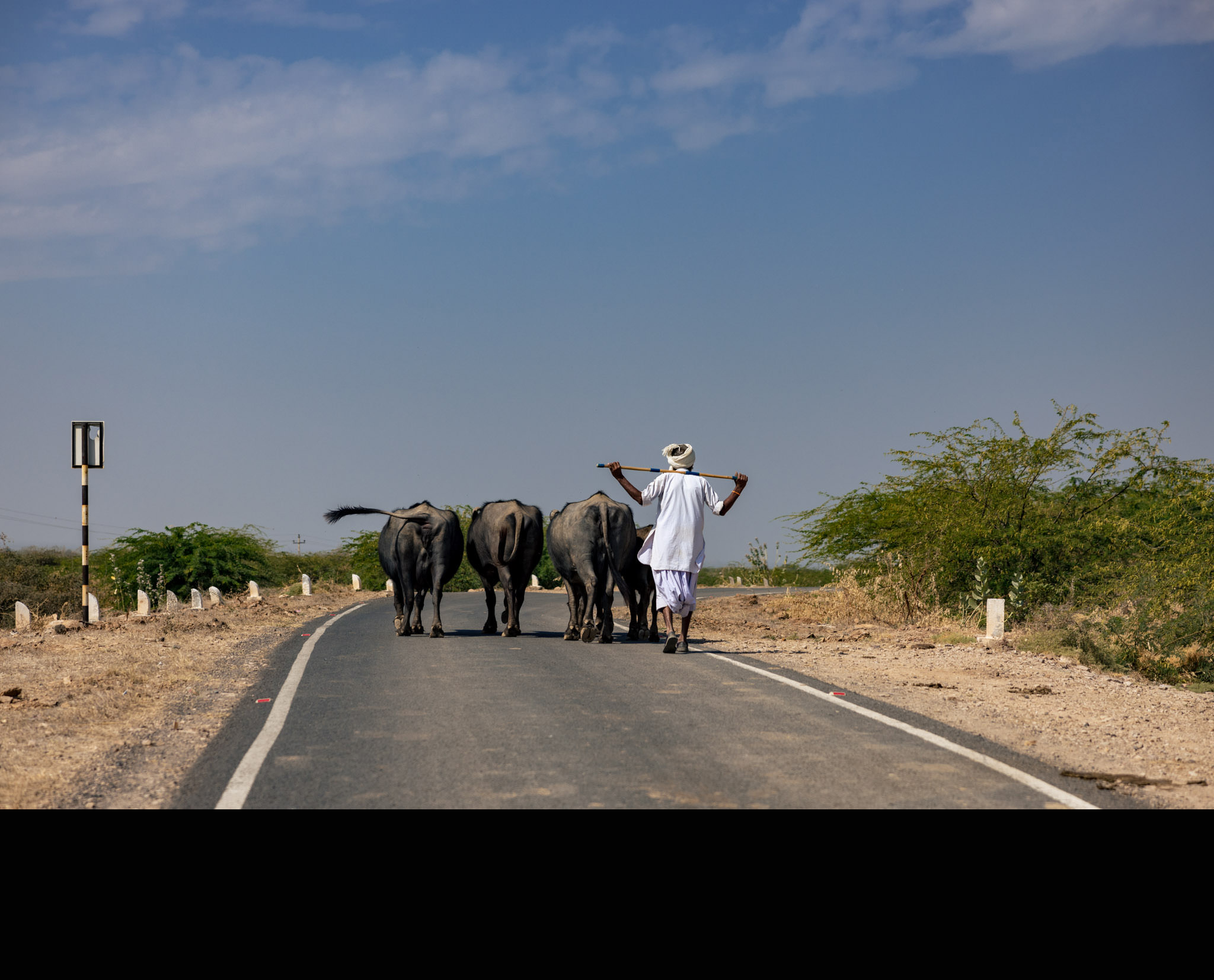
Once I had taken a couple hundred photos and picked my jaw up off the floor (and we’d posed for another half dozen selfies), we loaded back into the car and headed for our homestay in Dholavira. The 205-km drive would take about 4hrs. It was already after 4pm. Sunset was at 6:45. We knew we were pushing our luck, but only realized the true nature of our error as we passed cars with their high beams on, as well as camels, dogs, cows, goats, sheep, buffalo, transport trucks and farm vehicles unwilling to share the road, cars going down the wrong side of the road, motos, bikes, and – most alarmingly – a man napping on the roadside with his head on the tarmac.
Precisely none of this gave us any confidence that arriving in Dholavira in the dark was a good choice, but we held tight to anything we could, squinted through the bright lights, and pushed on until we got there. As a final gift from the “road from hell” gods, the road we were travelling on changed to a single lane of tarmac with a wide, rocky, dirt shoulder. It was the job of the person travelling shoulder-side to drop off the road when they lost each game of chicken. In the dark. I’ll let you imagine the squealing.
Dholavira’s main attraction is the Rann of Kutch: a huge expanse of salt desert on India’s western frontier, very close to the Pakistani border. Heavy rain during the last monsoon season means that they’ve got lingering water and lots of bugs, but water means flamingos and they were present in good numbers. We enjoyed sunrises and sunsets watching the birds as the sun dropped lower on the “Road to Heaven” (a laughable name – it was the same road we’d driven at night to get there) and moved on after two nights.
With the car packed and a hearty breakfast under our belts, we were ready to leave Dholavira when we realised we had a nearly bald tire that was now also flat. Our homestay owner was a total gem; he helped us get it changed using the entirely inadequate equipment in our car, and directed us to a garage 50kms down the road. We caused a bit of a stir when we pulled up in front of the mechanic, but Google Translate helped us get what we needed and, $12 later, we were back on the road with a newly fixed up (but still bald) tire in the trunk as a spare.
Along the way to our next stop, we encountered a police checkpoint. Rich slowed the car, rolled down the window, and one of the officers immediately began chuckling, which we took to be a good sign that we wouldn’t be facing any issues, and rolled on through.
Onward to Junagadh: messy, chaotic, but smaller and more approachable than Ahmedabad. Definitely not somewhere that gets Western tourists. We couldn’t have stuck out more if we’d been carrying a neon sign.
We visited the tiny-but-gorgeous Mahabat Maqbar Palace and tried not to be bitter about the fact that Gujarat Tourism charges an extortionate fee for using cameras on the property. While sitting across the road and looking at the palace, we decided to try some vegetable pakodas from a street vendor who was just getting rolling for the day, then branched out and tried his vegetable samosas with tomato chutney. As we sat on the bench munching on our snacks, he reached over and tipped out some dough sticks onto our little plate. They were so light and melty in my mouth that I can only assume they had to be absolutely loaded with ghee. Next, we headed to Uparkot Fort and paid that same extortionate camera fee only to discover that there’s absolutely nothing photo-worthy about the place (apart from us, apparently?! More selfies ensued…) and we should’ve reversed those two decisions. Bah.
One of the main draws to Junagadh is the nearby Girnar Hills. A major pilgrimage site, the Girnar Hills are home to 866 temples. Traditionally, worshippers walk up 9999 steps to make an offering at their temple, and then walk back down. A cable car now takes people up the first 5500 steps, but devotees continue to make the full trek. With temperatures sitting at a balmy 35C, we opted for the ropeway up and the walk down. After walking close to 6500 steps up and down to the mouontain temples, I can tell you that’s enough stairs to make my calves sting for two full days.
Besides being the starting point for the trek, the other draw to the town of Bhavnath is Bhavnath Mahadev Temple, a Shiva Hindu temple that performs its aartis (blessings) several times a day. We stuck around for the evening blessing so that we could get a better understanding of the ceremony, which involves the priest using incense and a flame-bearing lamp to offer light to the deity. The chanting and music are meant to help attendees clear their minds and the ceremony was a peaceful way to end the day – then the rope barrier dropped and attendees rushed to the inner temple doors like they were trying to get to the front of a concert. So, a mostly peaceful end to the day….
We had struggled to narrow down our destination options in Gujarat, having considered Dwarka, Somnath and Diu, but finally settled on driving through Somnath (with a brief, steaming hot stop to walk along their waterfront and gawk at the city’s main temple) and staying a few nights on the small island of Diu, a former Portuguese colony. We made the fatal mistake of basing this decision mostly on the Lonely Planet summary of Diu, thinking it sounded like a lovely base, and discovered that LP did us dirty once again. The entire city seemed to be under construction, with roads in varying states of (mis)repair; however, the residents are laidback and friendly, the hotel pool was a good way to keep cool in the afternoons, the fort made for a lovely daily evening view, and the food court was a lively spot for people watching. It would be an easy place to get to know people and settle in, if you could handle the dust.
After 10 dry and vegetarian days, Rich was excited to see beer and meat back on the menus in Diu. While reading restaurant reviews in an effort to choose somewhere to eat, he started laughing, “I don’t think I’d ever describe paneer as ‘juicy and perfect…’ Something tells me you got served chicken.”
On our final morning in Diu, we braced ourselves for one more big day of driving and headed off to Ahmedabad, armed only with a car horn that had about as much intimidation factor as the horn on the Fisher Price tractor I pedalled around the driverway in 1984.
We arrived at the rental drop off slightly shaken but entirely whole and undamaged, happily handed the keys back, and headed back out into the noise of Ahmedabad, feeling like we’d come back home (albeit briefly).
After a day of admin and more mutton samosas it was time to head for Rajasthan. We headed for the train station and I looked forward to somehow ridding my mouth of a layer of dust.
Grateful for: spare tires