
**As always, supporting photos are here.
The hike from Samdo to Dharamsala is uncomplicated; just another couple of hours of climbing high – another 670m “up, up, up” with a few narrow sections, landing us at 4475masl. Dharamsala is the last camp before the pass. It’s high, basic, and cold. Added to that was the fact that it started snowing with increasing vigour as the afternoon rolled on. As we watched pairs set out into the worsening conditions on short acclimatisation hikes while we got to curl up with our sleeping bags, we were extra thankful for our hike the previous day. Have at ‘er, suckers. 😜
When I say the camp is basic, I mean “snowing inside our room through gaps in the roof” basic. Ours was the last in a row of side-by-side rooms, and I had the bed next to the outside wall. A thin plywood sheet separated Rich from our neighbor, Eric, meaning they would later take their (previously non-existent) relationship to a new level and actually slept mere centimetres apart, listening to one another’s breathing as they settled into sleep. We probably would’ve had more privacy if we’d each shared a room with another hiker and shared that wall with each other. I was thankful that the camp was on a relatively flat plateau so the toilet shed was easy to get to. With the weather being so cold, it was easy to want to ignore nature calling, but an uphill climb to the toilet can lead to nature shrieking by the time you reach the door.
We were shocked to discover some significant snow accumulation by the time we reemerged for dinner, when we traipsed through several inches of fresh powder. Afternoon acclimatisation hikes had been abandoned as visibility diminished. Hikers gradually trickled into the dining room in a parade of faces that largely told the story of our trek; we were just missing the Danes and two of the Belgians, who were all staying at one of the other two lodges (we learned they had floor mats, making our plywood walls seem positively luxurious). Unable to use the wood stoves in the dining lodge, teahouse staff created a party atmosphere with porters and guides, who kept warm with plenty of dancing, while trekkers gradually gravitated closer together for added warmth.
Dinner conversation kept circling back to one topic: the weather. Everyone was feeling some nerves. Weather reports had been notoriously unreliable so far, so we didn’t put any faith in info gathered before we lost signal, but we were all unsettled by the amount of snow already on the ground, with more constantly falling. Mani confirmed that our situation could be precarious. If it continued to snow like it was, we wouldn’t be able to cross Larkya La Pass – the trail would be buried and the route would be dangerous. We agreed that we’d get up for 4am breakfast and make the call then as a group.
4am breakfast: more snow. We had a good foot of accumulation by this point and it was still snowing; there wasn’t a single guide in our lodge who looked confident. Breakfast was a quiet affair as we each waited to see what would happen. We couldn’t go back to Samdo because the trail was extremely narrow at times and would be treacherous in these conditions. Staying put would mean getting stuck for several days because there was more snow coming. We agreed to give it an hour and went back to our cabins.
Mani came knocking less than 15 minutes after we’d climbed back into our sleeping bags. As I opened the door, a short string of headlamps were visible on the hill leading away from camp. We sprang into action (not difficult, since we were already fully dressed) – it was clearly go time.
Little did we know, the Danes, Lauren and Jaro were part of a group that committed the night before to crossing the pass no matter what. They had modified breakfast timing by 30 minutes, collected their gear, and set off – it was their head lamps leading the way uphill the hill from the lodges. The Belgians’ guide, Thek, would play an especially critical role in breaking trail so that our entire group could cross the pass that day.
We trudged uphill along a barely-there path through the snow, constantly remarking how amazing it was that the lead group was willing to push through in such tough conditions. The advantage to the darkness, though, was that you couldn’t see how far you had left to go. It’s just you, your poles, and the footprints in the snow ahead of you. One step after another.
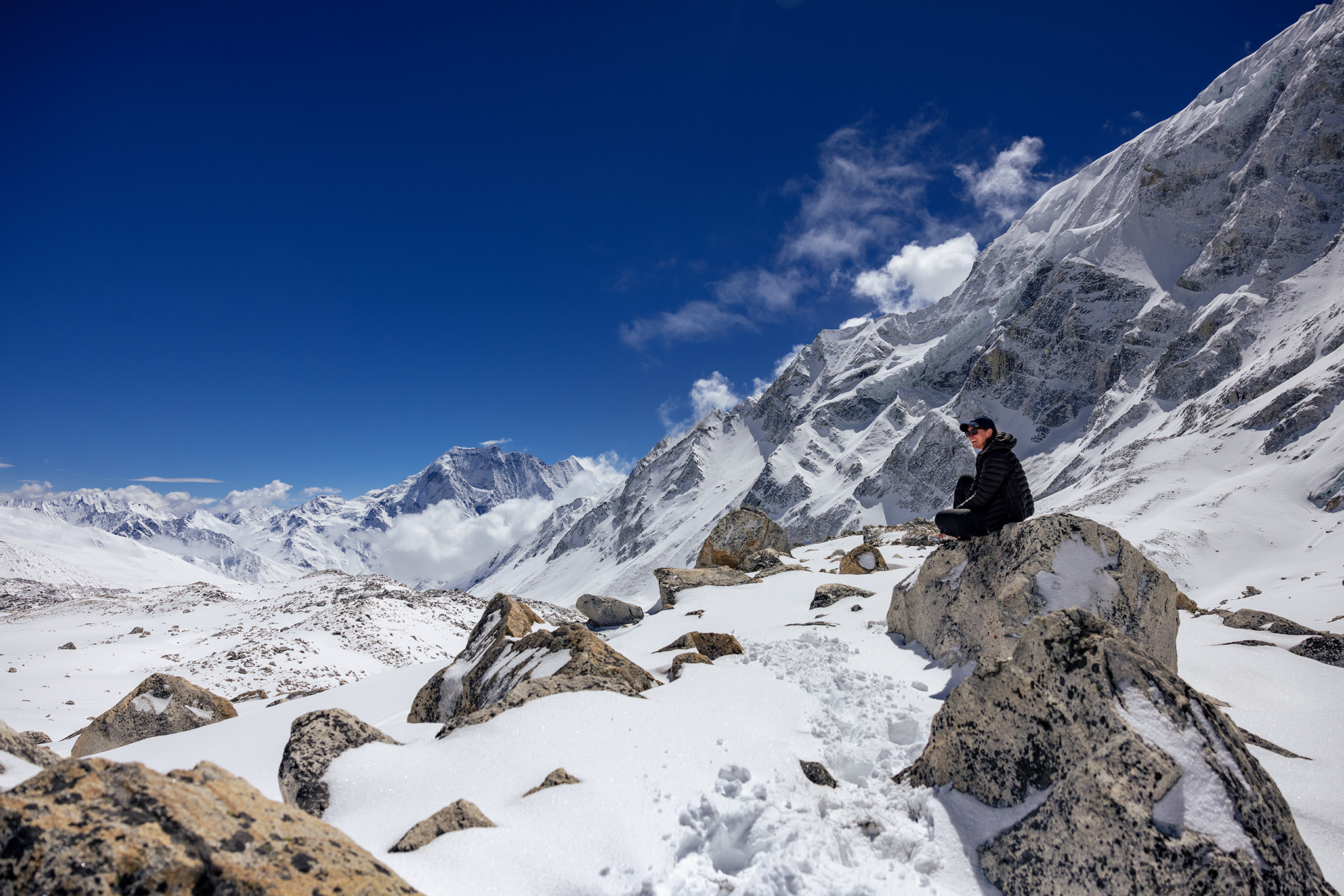
The rising sun added new elements to the trek. It highlighted the trial marker poles, which made breaking trail slightly less like guesswork (at least you knew what direction you needed to move in for the clearest path under the snow); it also highlighted the elevation markers, which made me even more aware of the climb. Most spectacularly, though, it finally gave us time to admire our high-altitude scenery. Standing on the side of a mountain, looking out at glittering snow and shadowy crags of rock in every direction, I could only laugh at the worries I’d had that we wouldn’t have much in the way of panoramic views.
We trudged uphill for another four hours through the deep, uneven trail being laid by our friends at the front. Throughout the morning, bonds were formed over shared awe and collective suffering. Each hiker was tasked with figuring out how to make the most of the struggle while also absorbing the seemingly alternate reality that surrounded them. All the while, the sun rose higher, bouncing unexpectedly strong rays off every single snow-coated surface, silently frying the skin of just about every foreigner on the pass. We watched as our friends pushed through moments of discomfort and uncertainty; we saw paces modified to reflect drops in stamina and difficulty breathing. Rich and Mani adopted a cycle of periodic rest breaks, while I pushed onwards, opting for the more continuous pace that was comfortable for my body, learned from last year’s training efforts. Immediately after I reached the sign marking my arrival at Larkya La Pass (5106masl), I flopped in the fresh snow and made a celebratory snow angel before heading back to the top of the incline so that I could welcome Rich and our friends as they each arrived amidst much celebration.
While atop the pass, we had as much time as we wanted to take photos and celebrate with friends. It was a brilliantly sunny day, the mood was high, and we had a ball acknowledging our triumph. My only other experience with long distance high altitude trekking was a Mt Kilimanjaro expedition that I completed back in 2006, when our time on the summit was brief because our (very skilled) expedition leader seemed hyper-aware of the health risks of staying at 5900m for any longer than absolutely necessary, so to have all this time to do what we wanted felt like a real gift.
The way down involves a massive descent of 1400m to Bhimtang (3700masl). For two hours, the mood on the trail gradually plummeted as everyone’s knees took an absolute beating as we slid our way downhill along a non-existent trail through deep snow. The advantage to these perilous conditions was that, when you did fall (every fifth step or so), at least you had a soft landing. The same wouldn’t have been said if we’d been descending in mud. As we arrived in the next village for lunch, exhaustion and sunburn were printed all over everyone’s faces. Two more hours to go.
I don’t know that I even processed the scenery for the final leg of the day. I know I had some (relatively) blistering paces compared to what I’d previously walked, since I jogged many sections of the devilishly rocky route in an effort to make camp appear faster. We arrived in Bhimtang exhausted but thrilled after finishing almost 17kms, and shared tired pre-dinner conversation with Marilyne, Daromir and Eric before packing it in for an early night. One more 19km day and then we were done.
As we set off in the morning, yaks were moving across the village’s vast open plateau and the sun illuminated Annapurna. We travelled on some seriously rocky, technical terrain and had 1400m of descent to cover in 19kms. Just as I let my brain wander off on a random path, I struck a rock oddly and went down hard. We were 3kms in. A few minutes to figure out how to weight-bear, and I was back at it, albeit timidly; a second stop about an hour later allowed me time to wrap it so that I could ease the limp. By the time we reached Tilije, 16kms and way too much descent after my wipeout and the location of our final teahouse of the trek, it became quite clear that I’d be resting the foot for a few days, which wasn’t a problem – the trek was done and we’d be catching a morning Jeep to Besisahar before moving on to Pokhara. For now, it was nothing that a bit of celebratory rum wouldn’t fix! We got glasses, surprised the guys with a small bottle of rum that we’d packed, and toasted to our shared success and their hard work. Guides are required in order to do the Manaslu Circuit, but are also a critical part of the experience. I’d peppered Mani for days with questions about his culture, his life, local details and language, and he’d happily shared with us, and we’d spent many evenings laughing with both of the guys. The idea that people try to circumvent regulations and avoid taking a guide galls me because it removes a critical part of the experience: human connection.
On that same note, a central element of the teahouse trek experience is the evening social time in the lodges. It’s a chance to get to know the faces that you see repeatedly on the trail as you leapfrog one another, and share meals, games of cards, seats around the woodstove, and travel tales both wild and tame while everyone rests their feet. We played cards each evening with Mani, always noticing Maji shyly watching from a distance, but he’d always decline invitations to join. By the time we reached Samagaun, we had a good sense of his personality and suspected he was interested but hesitant about his limited English. Easy solution: we changed the game to Crazy 8s because there’s less language required and from then on played together as a foursome, hooting with laughter over strategic surprises and unfortunate luck as we churned through the deck.
It’s not just about forming connections with guides and porters. In Jagat, we met Kimi (Germany) and Ryan (Australia), two backpackers randomly paired together for the trek. Somewhere between Jagat and Deng, while waiting under the shelter of a rocky overhang as a gigantic mule train slowly passed in the rain, we got chatting with Charles and Megan, two backpackers from just outside Quebec City, who we’d later reunite with during a couple of stops. My most memorable hug at the top of the Larkya La Pass would come from Megan, who was clinging to her motivation as she reached those final uphill steps and shaking with relief by the time she crested the rise. In Deng, we met Daromir and Marilyne, who came to Nepal from Belgium exclusively for this trek and who would end up being in the same lodge as us for almost the entire remainder of the trip. Namrung brought Lauren and Jaro across our paths – another two Belgians, they were on a three-month sabbatical and became known for setting a cracking pace each day, but will later become known for having an open parking spot in their driveway in Brussels. 😉 We also met Eric, an experienced high altitude hiker from Germany, who travelled solo for the trekking trip; Susanna and Dom were making their third trip to Nepal from Victoria and were on the circuit with their teenage son and his best friend; and Bjorn, Ole and Askar, a Danish father-and-sons combo who were on a really exciting sabbatical together for about four months – Ole was so grateful to accomplish the trek with his boys that he stood at the top of the pass and sobbed helplessly for 10 straight minutes. When it came time for the push up and across Larkya La Pass, each of these people would crystallise themselves in our trekking memory, and my group photo of the “leapfroggers” and many of our guides was one of those unforgettable moments of celebration.
On our last morning, after taking one last “Rich Money Trekking” photo in front of our waiting Jeep, we climbed in and headed for Besisahar, winding our way through Annapurna crowds (the size of which instantly reassured us we’d absolutely made the right choice with our trek) and gradually leaving the dramatic views behind. We’d done it: 150kms walked; 8649m of ascent; 7168m of descent in ten days.
More than any feeling of breathlessness or struggle, more than the constant tension in my calves as we pushed uphill or the pressure in my knees as we pounded downhill through barely-there paths in thigh-deep snow, my lasting memory of our time in the Himalayas will be the movement of my head, as I slowly shook it from side to side while standing slackjawed in amazement: of my surroundings, of the privilege of getting to stand in each place, and of the will of the local people who built homes and teahouses and communities in these far-flung corners of the earth so that I could eventually make my way to them.
Grateful for: knowing how to “be where my feet are”