
**As always, supporting photos are here.
At the end of our trek, we bid Mani and Maji an especially fond farewell and piled our sunburnt selves onto the bus to Pokhara.
As a destination, Pokhara was absolutely nothing to write home about. It’s the country’s major tourism centre and is primarily full of shops selling “authentic” yak wool items, pashminas, outdoor gear and trinkets galore, and a bizarre mix of tourists that includes those on cultural tours; trekkers who are pre- or post-trip; and a special population of performative travellers in billowing layers of clothing fresh from the markets, walking barefoot and “namaste”-ing their way through every greeting to a Westerner as they undoubtedly attempt to find themselves amidst a tangle of prayer flags.
Realistically, we over-committed in advance and could’ve done with skipping it altogether but after spraining my ankle on the last day of the trek, having the extra time wasn’t a bad thing. We made the most of our time there. We ate well (yes, I know – I can hear your shock from here) courtesy of Sherpa Kitchen, Gantavya Restaurant and Sarduba Tibetan Restaurant, who each served up some seriously juicy momos and thukpa with enough chilli to show they mean business. I spent one entire morning journalling and overindulging on 2-for-1 cortados at Himalayan Java Coffee until I was so well-caffeinated I could see time. We endured a wildly unsuccessful trekkers’ massage that included a therapist who had the church giggles and who then almost had to peel me off the ceiling after she tried to manipulate my foot in a manner for which my ankle – obviously twice its partners’ size – was clearly not prepared.
Most importantly, we slept well courtesy of Mountain House, where we revelled in having oodles of space to spread out our belongings and reorganize after the trek, and also had room to enjoy tea and do some critical planning regarding next steps which had become a more complicated choice than originally expected. Monsoon season had arrived early in Pakistan, our intended next stop, and a string of landslide damage and casualties meant we were now faced with having to choose an alternative destination. We had seen evidence of the havoc that landslides can cause in Nepal and didn’t want to flirt with that particular beast.
After we arrived in Pokhara, there was a day’s delay getting our bag shipped on the bus from Kathmandu, but you’ve never seen two people as excited to pay for laundry as we were once it arrived and we got to change out to the same set of clothes we’d been living in for 13 days. If it weren’t for the fact that my ankle sprain meant I had feet that looked like they belonged to two different people, I would’ve literally cartwheeled over to the laundry shop. Rich kindly obliged and did the errand instead, minus the cartwheels.
Smelling fresh and carrying a few thousand extra post-trek calories, we happily got out of town and set off on our updated Nepali adventure: instead of heading straight back to Kathmandu, we decided to take advantage of the extra time we’d gained by cancelling our Pakistan plan and add a three-night stay at Barang Village Community Homestay and then a couple of nights in Bandipur.
Getting to Barang Village is quite straightforward from Pokhara. A 40-minute local bus delivered us to the nearest village and then we faced 30 straight minutes of stair climbing in brilliant midday sun. It was all the reminder I needed that self-portering on Manaslu would’ve absolutely been the wrong choice.
Feeling marginally short of death and wondering why we didn’t just wait and take the last bus of the day, which stops in Barang village itself, our sweaty selves were greeted by Krish, the youngest brother in our new “family.” With great amusement, he marvelled at our fatigue then showed us to our room so we could drop our bags and get settled. The accommodation was far more generous than I’d anticipated: attached bath, two windows offering lots of light, power in the room. We were set!
Krish collected us from the dining room-cum-patio to take us on a walk, but not before looking at our feet and telling us to change into closed shoes. While he effortlessly glided up the steep village terraces like a ghost hovering just above ground (in broken Crocs, no less!), we scrambled and stumbled along the goat tracks like we’d never encountered hilly terrain before. After walking through a massive yoga ashram run by the country’s leading guru, we joined a couple of kids playing at the community hall and volleyball pitch. My foot was doing better but was absolutely not ready for hillside volleyball so I designated myself as team photographer and made friends with some kids who were especially keen to learn how to push all the camera buttons, while Rich learned that volleyball games played beside steep drop-offs include frequent breaks to chase an errant ball downhill.
Over the course of our stay, we learned how they use oxen and hand tools to prep the many terraces (literally every available surface larger than about 8sq ft) for farming and visited a small local temple dedicated to their ancestors. It’s only used for rituals every few years, but these rituals mean a goat is slaughtered and rice pudding – a real treat – is served, so I noticed that Krish spoke of this temple with particular fondness. We also got to try on some traditional dress and help collect foliage for the farm animals, which is a daily chore that takes a couple of hours of foraging in order to collect enough ant-free greenery to feed two oxen and several goats. As Krish showed us around for our first day and a half, I couldn’t help but notice that he demonstrated a level of poise entirely uncommon for a 16 year old boy; it was clear that he fully understood the importance of the homestay and what it could help his village accomplish.
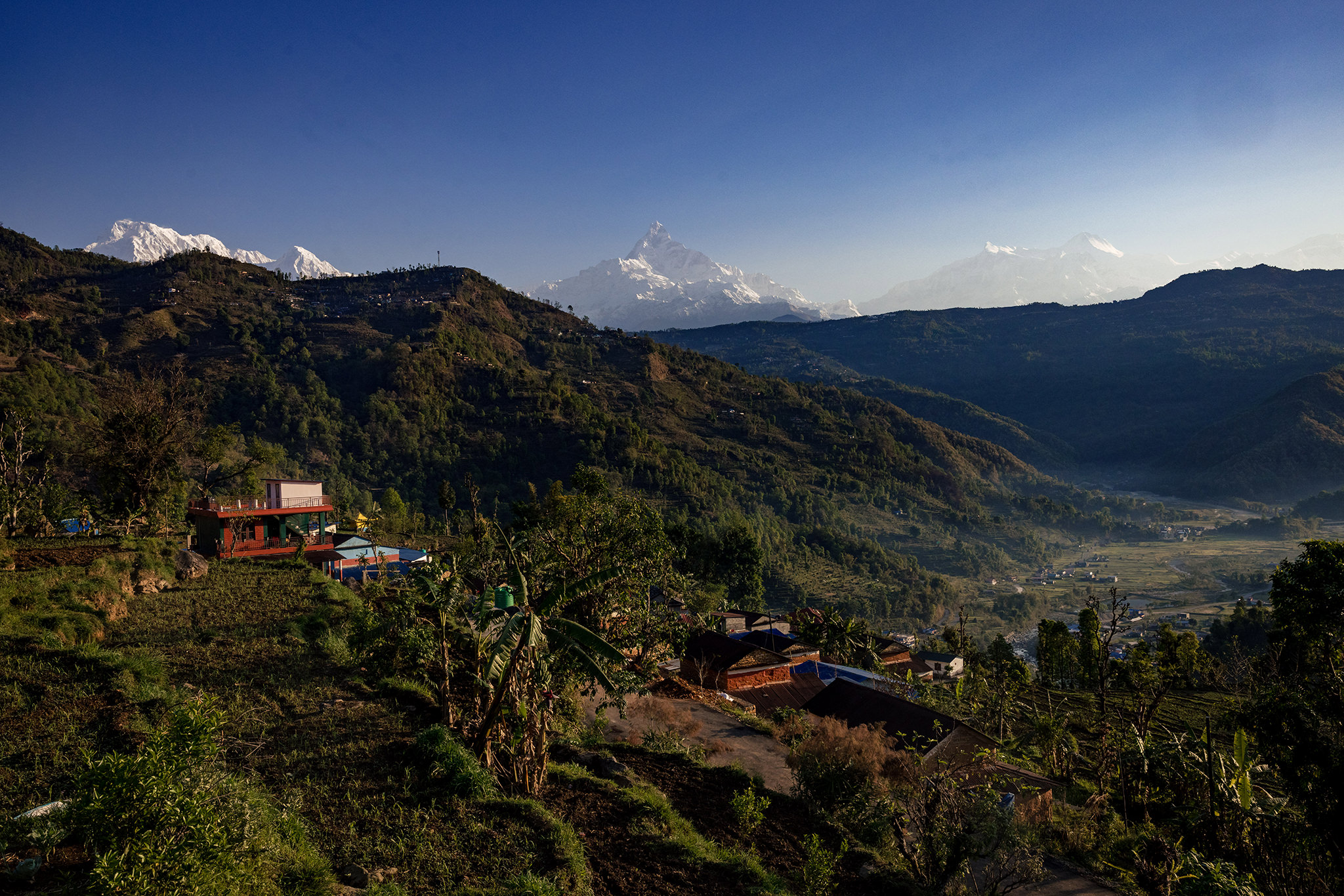
While learning about daily routine, local traditions, and religious rituals was all extremely interesting and I certainly never tired of marvelling at the ever-changing view of Machhapuchhre and the Annapurnas, I most enjoyed getting to know Krish’s family. In a twist that I think ultimately worked in our favour, Asmita, who speaks the most English and would’ve normally been our host during our stay, was wiped out by illness until our last morning. This meant we got to spend time directly communicating with other family members who would normally rely on Asmita for translation once Krish had to go back to Pokhara for school, and the shared lack of language skills (our absent Nepali and their limited English) allowed us to bond with humour and patience.
Tara, Krish’s other sister, is reserved and far more timid with her English, so I took it as a win when I finally got her laughing at some (probably terrible) joke I made while we were out collecting foliage. From then onwards, she seemed to relax and realise that we’d be able to figure one another out despite the language barrier. She’s also a chapatti master and, having made more than a few myself, I enjoyed watching her dexterity at handling the dough during dinner prep.
Tara’s son, Anuj, is mischievous and playful, but also starting to assume some minor responsibilities for guiding the guests – but we had subtle reminders that he’s still young (11). While Tara led us out to gather foliage for the animals, Anuj took me under his wing, chatting as we went. When we went on a side quest to pick berries, which are his favourite, he happily cleaned out my stash when I offered to share my pickings. Half an hour into that walk, he confidently announced that I’m the big sister and he’s the brother; he became Bai (“little brother”) from that point on. He also latched onto Rich and seemed to particularly revel in the attention from their exchanges. That’s when I realized that, with most Nepali men – his own father included – leaving to work in the Indonesia, Malaysia or the Middle East (or West Asia, as we’ve learned to call it), having the attention of a 45 year old man who likes sports and has a ready laugh focused on you is pretty rare. No wonder he seemed to gravitate to Rich.
The village’s biggest celebrity, though, comes in the smallest frame. Tara’s mom, whose real name I never learned, stands no taller than 4’10” but her personality is ten times larger. It’s fascinating to look through the community’s Instagram account because she manages to remain entirely anonymous, yet she’s so widely adored by every person who meets her. To those much younger than us, she’s Aama (grandmother), but I quickly came to call her Didi (Nepali for “older sister”). At the start of each day, she would enthusiastically holler, “Subha bihani, Bohini!” (“good morning, little sister!”) and I’d happily holler in return. Didi may have no English, but she certainly has boundless energy. Her day starts before 5am with Hindu prayers and offerings at the family shrine that each household builds in their yard. Then it’s garden work, blessing each family member (us included) when they wake, making breakfast, taking care of the animals, making tea for guests, household repairs, making lunch, laundry or household chores, garden or farming work, more tea to offer to homestay guests, dinner, dishes, bedtime. Are you tired yet? I never saw her sit down! With barely a word of English spoken, she managed to make each of us feel welcome and cared for – like we’d found our own home in Nepal.
With one daughter out of commission for several days, two sons away for work (one is a guide, one runs the business side of the homestay from Pokhara), one son away on weekdays for school, and a husband who seemed unable to help (we’re not sure if he’s injured or ill of health), that left a lot to land on Tara and Didi during our stay (along with two other guests), but they handled it with grace. Part of the fun of being at the homestay is figuring out how to help wherever our meagre homesteading skillset allowed, particularly in light of them being short of hands. We were put to work one evening making dinner in the prematurely gathering dusk, the crepuscular light exacerbated by a power cut from the afternoon storm. Rudimentary tools and a combination of outdoor kitchen (where they’re permitted to cook over woodfire) and indoor kitchen (gas cookers only, after the government learned that smoke from indoor woodfire cooking was causing eye damage) made for an eye opening experience, but after three months away from any kitchen of any sort, I was more than willing to figure it out and get stuck in. I’m positive that we were in the way more than we were helpful by times, but Didi never let on and always seemed happy to have us – just don’t forget to take your shoes off before going in the kitchen or you’ll get scolded!
After dinner on our final night, we sat and helped Didi make malas: necklaces of bougainvillea blossoms and pine tips. The following morning, the mountain peaks all came out to see us off as we enjoyed breakfast with a full view of the range and then received a farewell blessing from the whole family: a prayer scarf, which is meant to be even more powerful when used on top of mountains because you’re closer to the gods; a Nepali coin purse for me; a traditional Nepali hat for Rich; miniature prayer flags; and our malas. As they wished us farewell and safety on our journey, it was hard not to feel like I was leaving my home. What a gift to get to share a little snippet of their life and culture alongside them.
We hollered a final goodbye to Asmita, Tara, and Didi, and followed Anuj down the hill to the bus stop to catch our onward connection to Bandipur, knowing we’d experienced something special.
Grateful for: the shared language of laughter