
**As always, supporting photos are here.
Our Manaslu Circuit departure day arrived and it was time to leave Kathmandu Boutique Hotel and head for Machhakhola, our first teahouse stop and the entry point for the trek. We had our three bags packed and ready to be put in the right places (one to leave behind for when we came back to Kathmandu, one to send to Pokhara in two weeks’ time, and one to take with us) and we headed down to meet Mani in the hotel garden so we could get things underway.
We climbed into our waiting Jeep out on the main street, getting things settled and organised, while also being introduced to Maji, Mani’s brother-in-law, who would be our porter. What followed next would best be described as a six-hour drive broken into three parts: two hours on something that was mostly road, followed by two hours on something that was almost road, and a final two hours on something that was most definitely not a road. After this many years of travel, my benchmark for “rough drive” comparisons is a bone-jarring Jeep ride in the DRC that was the equivalent of driving into the jungle and then veering sharply off course quite literally straight through the trees, and involved my backside spending more time in the air than on the seat. So, by those standards, even the last two hours of our ride to Machhakhola were perfectly tolerable. The same can’t be said for people who made the same drive by local bus: they arrived four hours after we did, looking shellshocked and exhausted. A new friend – who is anything but fragile – told us later in the trek that, after arriving in Machhakhola and checking into their teahouse, she sat and cried for a minute because she was so overstimulated from the bouncing bus and the pounding music (because almost every local bus ride comes with its own soundtrack). Thank God for Sujal casually mentioning that a private Jeep would be far more comfortable, even if it did cost us $110USD extra.
From Machhakhola, the trek began in earnest and with increasing excitement. Each morning, Mani and Maji greeted us with big smiles, and we took a daily “Rich Money Trekking” photo before setting off. Maji typically set off ahead of us, our bag loaded on his back and the weight distributed using the traditional forehead strap called a namlo, and he usually reappeared at our lunch stop, when we’d holler his name and he’d be ready with his customary grin.
On our first hiking day, we opted for momos at lunch. We didn’t think about the fact that momos are made fresh. A cook can only make one dish (or two servings of the same momos) at a time; plus, guides and porters are always served after trekkers, so their lunch can’t be made until yours is done. Our lunch break took almost two hours. From this point forward, I referred to momos as “slow-mos” and we never made the same mistake again. It was during this same lunch break that Mani put some fresh mint in his soft drink because he thought it would make it taste nice. Spoiler alert: it didn’t, and the mocktail became known as Mountain Dew Not.
Over the coming days, we excitedly crossed suspension bridges (some well over 200m long); made room for passing mules (once in a group so large it took 45mins to finish passing us); and constantly marvelled at the changing landscape. For four days, we hiked 17-19kms – a pleasant surprise given that we expected to be hiking 20-22kms per day – as we moved from Machhakhola to Jagat (1340masl) to Deng (1860masl) to Namrung (2630msl) to Samagaun (3520masl), stopping in rural villages for tea breaks and lunch along the way. We set a fairly fast pace for the first three days to take advantage of the lower altitude and opportunities to relax in camp for a little longer each afternoon, and enjoyed the gradual increase in elevation along with the changes it brought in vegetation and views.
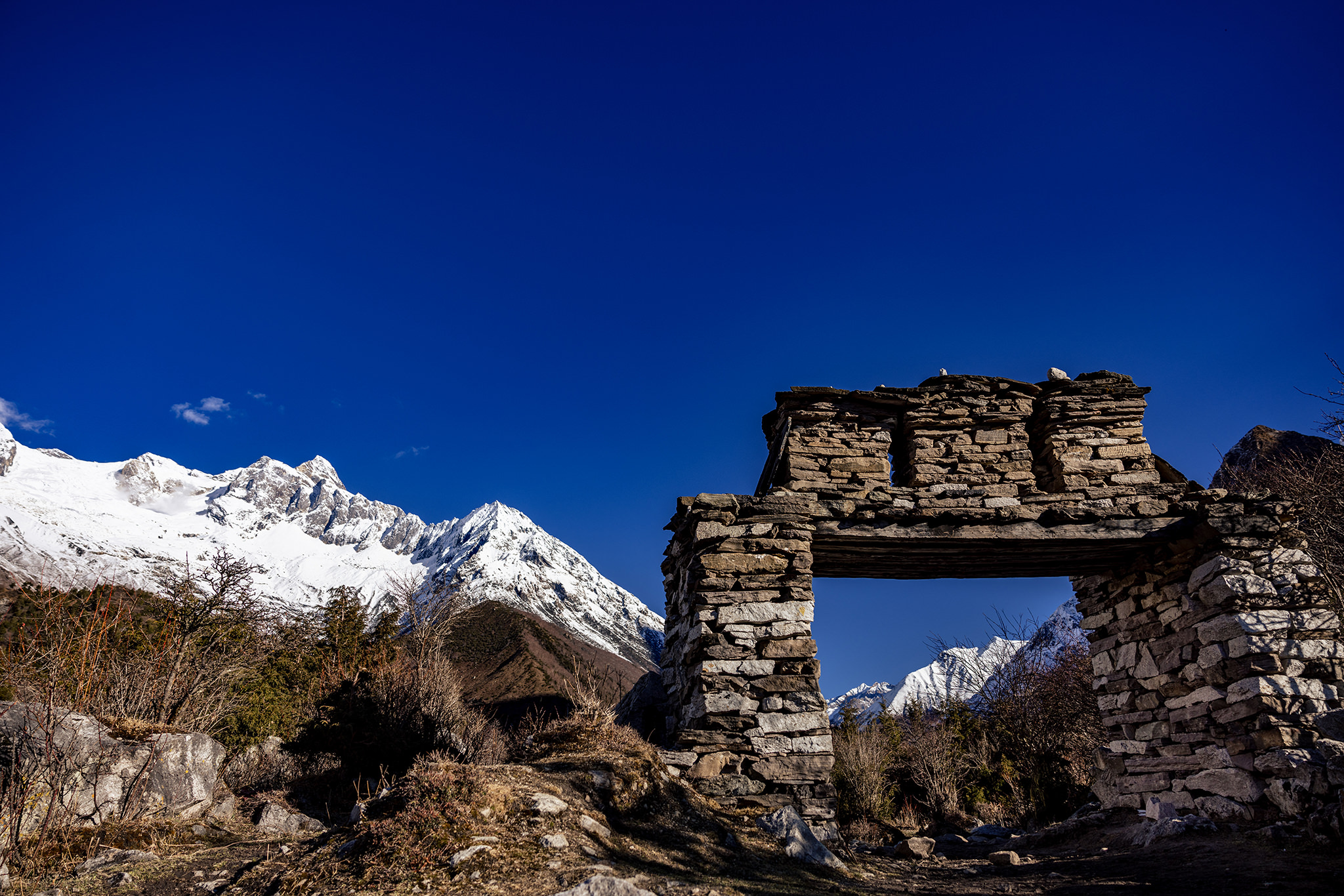
Each day brought something different that added at least four new “Wowwww….”s to my collection. Our walk to Jagat brought us our first views of distant snowy peaks. The route to Deng brought us some of the most dramatic suspension bridges, including one that Mani wisely waited until after we’d crossed to tell us a landslide swept a tourist away the previous year on that same bridge. We went to sleep with heavy cloud cover in Deng and woke up to spectacular mountain scenery, a pattern that would become the norm as we climbed higher but was no less thrilling each morning. On day four’s walk to Namrung, we had lunch in a village where a group of preschoolers kept me entertained for our entire break and one toddler found peek-a-boo so entertaining that our game lasted almost an hour and he threw his head back in silent mirth every time we locked eyes. We also saw mountain goats, and a pair of langurs raiding potatoes from a farmer’s field. A big stone painted with a welcome message for those arriving at Namrung came a good 2kms sooner than we expected on day four, giving me all the excuse I needed to do a happy dance in celebration. While our pace wasn’t especially tiring, the final four kilometres had been mostly stair climbing and I was feeling the distance in my feet after 54kms.
At dinner that evening, Mani visibly relaxed; we’d been in landslide territory for three days, with daily rain actively adding to the ongoing risk of slides. “Tomorrow, not so challenging – just up, up, up,” Mani happily declared as he put the “brief” in “route briefing,” as was his style. “Mani, I’m going to need to know what you think is challenging if ‘up, up, up’ doesn’t count,” I replied. It turns out that the challenge came from the risk of landslides. He was prepared to handle the increasing elevation, but landslide risks put him on edge.
Departure on day five was when things started to take on a different tone. We were already starting our day on the threshold of altitude sickness or acute mountain sickness (AMS) territory, but our approach to Samagaun (elevation 3520m) would propel us firmly through that door. While we’ve spent a good amount of time at high elevations on previous trips with no issue, altitude sickness can strike at random and I just hoped we’d dodge it. As sobering reinforcement during our hike that day, we began encountering the first of the trekkers who’d made the turn back, unable to combat AMS symptoms or snow much further along the trail. There’s no escape route on the Manaslu Circuit – if you fall victim to AMS or you get injured, your only way out is turning back on yourself. I just had to hope that Rich’s glass ankles would hold for eight more days.
The hike to Samagaun was pretty cruisy when you consider we were on our fourth consecutive big walking day and it included some substantial gain. We spotted plenty of mountain goats and “mad honey” hives (though I’m not sure whether it’s the bees or the honey collectors who count as mad, since they seem to colonise in the most impossibly difficult locations), and stopped at a bakery on the route that produces goods made from high altitude apples. Late in the walk, Mani pointed out the village way across the valley which felt far but not intimidating – we were generally feeling good.
That is, until confronted with a series of seven steep switchbacks to reach a suspension bridge that would lead us to the village’s plateau. Jesus. It was time to put my head down, let the trail running training take over, and get it done. The climb was unpleasant, but I was so excited to have the village in my sights that I trotted all the way across the field and into the village, a herd of yaks served as our welcoming committee. We got settled in our teahouse, where we had the unfortunate luck of getting a room almost right beside the village’s mani wheel – a giant, bell-ringing cylinder that almost everyone in the village spins on their way past while muttering Buddhist prayers, even if passing at 5am – and spent the rest of the evening engrossed in multiple rounds of cards.
We’d had some great morning hikes but experienced a bit of rain at lower elevations and had, by now, generally come to expect rain or heavy cloud daily by 2pm. Samagaun, where we had an acclimatisation day planned, was also where the temperatures started to drop quite noticeably. Significant snowfall greeted us on our first morning – a surprise to everyone, based on the amount of laundry that had been hung out overnight.
Buried trails and difficult footing changed the direction of our morning hike from a notable monastery several kilometres away with great valley views (of a valley that was now completely shrouded in snow and cloud) to a nearby lake that still offered some good elevation gain. We stuck to our usual early departure time and made first tracks on what was almost definitely not a trail to the lake. Mani loves a good shortcut, but that definitely didn’t work in our favour in the snow; however, the mood was high and I was giddy over the snowy landscape. As Mani passed under a cluster of trees loaded with snow just ahead of me, I knocked the branches with my pole. “Ohhhh! Happy birthday!” he shouted, as powder rained down around him like confetti. I’m sure you could hear our shared laughter from the next valley over as we dodged tree confetti and also yaks, which appeared like silent snowy sirens out of the trees (who knew they could be so quiet?!).
Overnight, Rich had started to fall victim to some GI distress, which was a worrying sign of potential AMS. He soldiered through the hike like a champ (albeit with plenty of quiet grumbling), but the deserted tea hut at the top of the lake may have come out slightly worse for wear. We had made an intentional choice not to bring Diamox with us in favour of maintaining hydration and using ibuprofen as needed, but I couldn’t help but hope that his evening beer consumption in the early days hadn’t just scuppered his chances of making it to the pass.
Mount Manaslu greeted us on our second morning in Samagaun, shining like a beacon in the dawn light and giving us a gorgeous backdrop for our hike to Samdo (3790m) – a short day that only took us about 2.5 hours. The route seemed deceptively flat until the last possible minute, when we were gifted 15 minutes of near-vertical stair climbing, which is a treat at 3700m, I assure you.
A brief pause at our teahouse for check-in and a lunch break came with a sobering reminder that we were in for some cold weather: we had no water. The pipes were frozen, as was the water in the buckets typically used for bathroom washing and flushing toilets. The teahouse dining room was full of nervous chatter about the weather forecast. Some people had tight timelines and flights to catch; forecasts were proving to be wildly unreliable, but a weather delay could be disastrously expensive for them. We listened empathetically, but did our best not to get caught up in the worries. We had the privilege of time on our side.
Speaking of which, in less time than it took Rich to correctly pronounce “Dharamsala,” we were back on an uphill trajectory, completing a second acclimatisation hike that had Rich – still experiencing GI troubles – grumbling so much that I thought he might throw a proper tantrum. His opinion of the hike differed greatly from that of a pair of seniors who had blasted their way up ahead of us and who told us that this style of hike (1km uphill with 24Om of gain) is their idea of fun. Our resulting conversation with them was brief, lest Rich’s guts take over his brain function.
Our “rest” day in Samdo brought better news. Our pipes froze again overnight, but we celebrated because Rich had shaken off the last of the AMS symptoms and was in good shape. We had a plan to hike to the Tibetan border, which we’d been told (or so we thought) wasn’t too far through an adjacent valley. Maji was taking advantage of a full rest day – important for porters as they prepare for the push into the high elevation camps – so we set off as a group of three just after 7am before the sun started to melt the snow and make the path more difficult as it turned to mud. Our route ventured into territory where no one had walked for days, as made clear by the total absence of footprints anywhere through the valley.
Total absence of human footprints, that is. Less than two hours into the hike, Mani stopped and pointed. Tracks. With claws visible in the snowy prints. Snow leopard tracks. We were looking at a very fresh set of prints from a large leopard accompanied by a smaller one, and we must’ve crossed paths with them already because they were heading along our same route but in the opposite direction. Nevertheless, heads were on a swivel as we looked at evidence of leopard activity for the next several hours.
After about 90 minutes, Mani said we were over halfway there. After two hours, it “wasn’t much further.” After three hours, faced with a punishing uphill climb that left us winded every 10 minutes, a guide who was hobbled by some knee pain, and a border that remained out of sight, we made the choice to turn back on ourselves in favour of potentially spotting those elusive snow leopards. We had accomplished our main goal of gaining extra elevation, and there was no formal border or village waiting for us, so we decided we’d had enough. We headed back to the lodge full of excitement about our close encounter, with an extra 16kms and 925m of elevation added to our legs and lungs.
The next day, we’d head for our final camp before crossing the Larkya La Pass.
Part II coming soon!