
We stumbled upon a direct flight from Varanasi to Kathmandu entirely by chance – it only runs a couple of days a week and I found it just by checking flight prices a day either side of when we thought we wanted to fly. Fortunately, it saved us six hours of travel because we wouldn’t have to connect via Delhi, so the option of staying an extra night in Varanasi and catching the early morning half hour flight was a no-brainer.
It turns out that Varanasi airport is an experience in itself: our check-in counter changed three times while we were standing in front of the check-in desks; our flight was initially assigned to Gate 5, which doesn’t exist in an airport that only has two gates (neither of which, much to my amusement, is Gate 2); immigration has set hours that aren’t posted, so you just sit and wait until someone shows up; and, upon boarding our very small plane and taking our seats in the emergency exit row, the safety briefing consisted of a flight attendant pointing at the doors while saying, “Emergency. Don’t touch.”
I had really hoped for Himalayan views on our descent into Kathmandu, but the haze that we’d become so familiar with in India robbed us of any peeks at the peaks. Given that I spent most of last spring and summer doing mega-hikes to summits where the views were almost always entirely obscured, I’ve gotten used to this outcome. Better luck next time!
When planning our route, we’d initially expected to go from Sri Lanka to India and then do some hiking in northern Pakistan in preparation for trekking in Nepal. As we approached the end of our time in India, the plan began to shift because Pakistan declared itself to be at war with Afghanistan. There had been some bombings and we were monitoring the news, but decided to change our route in order to give it time for the geopolitical situation to become more clear as far as tourist safety. Nepal certainly seemed like the logical way forward at that point.
Our main purpose for going to Nepal was to complete a multi-day Himalayan trek along one of the country’s teahouse routes, which Rich had dreamed of doing for the past 20 years. The Annapurna Circuit is the most famous, as far as teahouse trails go, but I’d been reading that it was heavily over-trafficked and it seemed that we’d missed the “ideal” Annapurna era, where villages were uninfluenced by mass tourism, by about 15 years. The Manaslu Circuit, however, seemed to offer the mix of serenity, remoteness and culture that we were looking for, and Rich agreed that it sounded like a good option.
We’d gotten a tip from a fellow backpacker that Kathmandu Boutique Hotel (KBH) was a great place to stay in the city and had a trustworthy travel desk, so we booked ourselves in for a couple of nights, and started our stay by getting info from them before setting out to do some comparison research. We’re accustomed to agencies doing a hard sell and seeing a fair bit of variation in package rates, so we were surprised to discover that all four travel agencies that we visited were happy to give info without pressure and the prices had only minor variances. KBH wasn’t hands-down the cheapest (lining up details started to feel like comparing Granny Smiths to Fujis), but we decided to trust Sujal and confirmed our tour with KBH, which would end up being an excellent choice for us.
We planned to meet with our guide the following morning so that we could discuss gear and go buy what we were missing. Because most of our travels were mostly in regions with very high temperatures, we’d made the decision back in December to only travel with some critical cold-climate basics – thermal layers and hiking boots/shoes – and then buy the rest when we arrived in Kathmandu, where North Face and Kathmandu knock-offs are available at a fraction of what the equivalent gear would cost at home.
At 9am on our second day in Nepal, Sujal introduced us to our guide by saying, “Hahaha It’s funny about your names… You’re Rich and this is your guide, Money.” And so, our Rich Money Trekking adventure was born (Money is actually spelled “Mani”). Mani took us to a shop where we got outfitted with microspikes, gaiters, and fleece mid-layers, plus down jackets that we rented and odds and ends like an extra headlamp and water bottle for me and a waterproof outer layer for Rich. All told, the entire collection cost us less than $140CAD – a price tag that was more than we’d remembered to budget for but also well worth avoiding having to carry all that bulk for the first six months of our trip. Shopping complete, we had a day and a half to explore Kathmandu before we left for our trek.
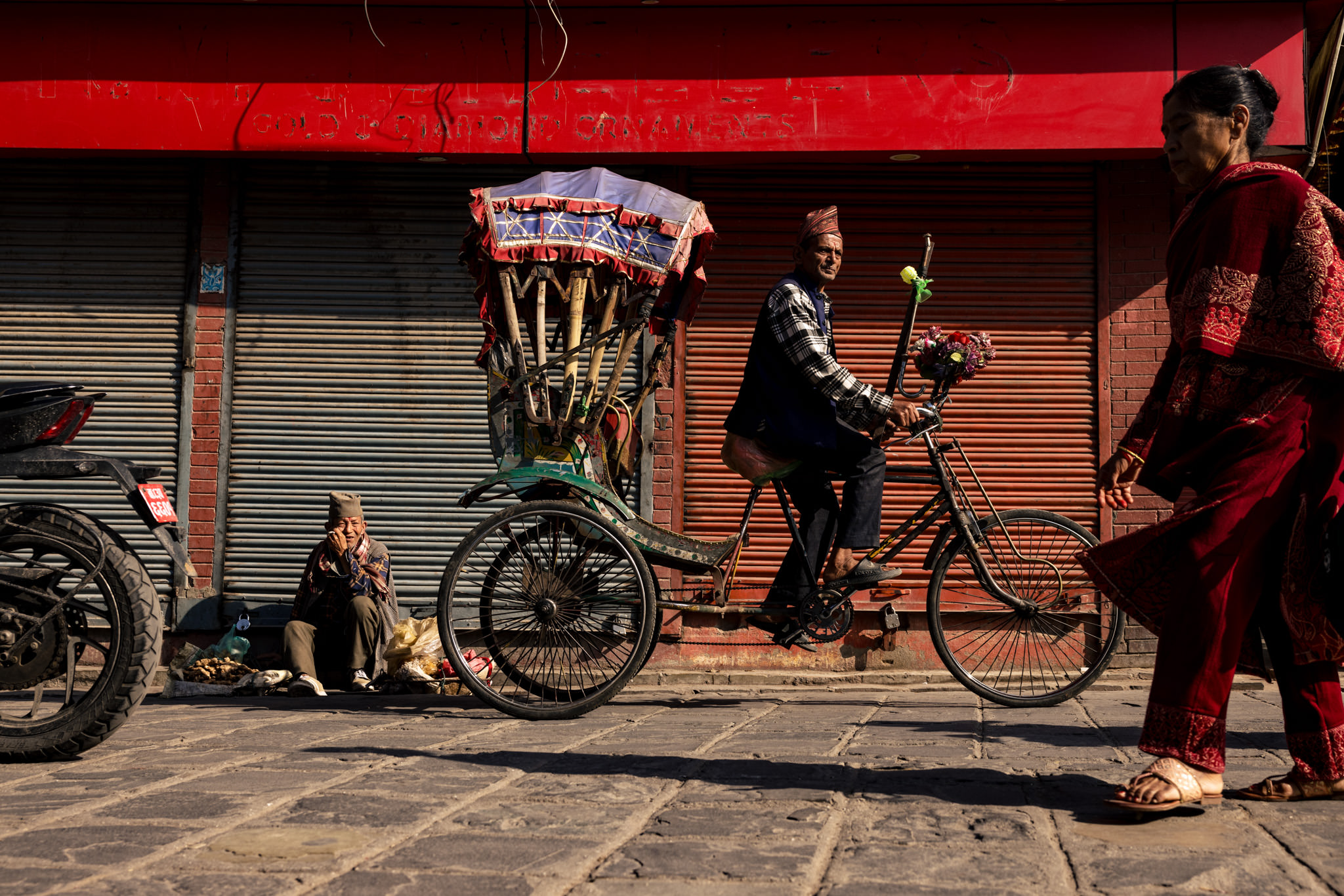
We proceeded to learn how many momo meals in a day is too many (the answer is three, even if you have a different type each time) and had our first taste of tongue-tingling Mongolian laphing noodles (seriously delicious); we did a morning walk across the city to Swayambhunath, a hilltop Buddhist temple brimming with macaques and langurs that is incredibly peaceful in the mornings before the crowds get dense; I delighted in discovering how light, people and pigeons shifted through Kathmandu Durbar Square (which, as an aside, costs an astonishing $10CAD per tourist, even just to walk through); and we reorganised our bags: one to come with us, one to send on the bus to meet us in Pokhara, one to stay in Kathmandu for us to collect when we returned.
Kathmandu proved to be an entertaining source of head-scratchers. Shrines appear, sunken into the middle of roads, without warning; trees sometimes sprout from the middle of a lane in the same fashion. Drivers appear to use pedestrians as target practice rather than objects best avoided and I found myself squashed up against buildings or diving out of the road on many occasions. Sidewalks start and stop without warning or logic, and you turn tight corners at your peril because there’s almost definitely a motorbike turning the same tight corner but travelling in the opposite direction. Telephone poles are so overloaded with wires that it’s a miracle they don’t create their own daily fireworks displays. After the curiously warm welcome we received throughout India, the indifference with which we were greeted – or, rather, not greeted – on the streets of Kathmandu came as a surprise, but was understandable (and refreshing) given how many tourists file through the streets of Thamel, the city’s main tourist district.
The architecture in the city is a combination of remarkably tidy stucco mixed with a smattering of buildings with tiny, low doorways and skewed wooden beams. It wasn’t until I read about the rebuilding of one of Kathmandu Durbar Square’s temples that had literally shaken itself apart that I realised this juxtaposition is because much of the city crumbled and was rebuilt – 600,000 structures were destroyed in the 2015 earthquake. The current state of the city is truly remarkable when you consider the astounding cost involved: the country sustained $10 billion in damages, which is almost half of the country’s GDP.
In the background while all of our exploration was happening, I nervously tried to mentally prepare for a 12-day trip that would include hiking multiple consecutive 20+km days, knowing that I arrived in Kathmandu feeling about as prepared for our trek as a Sri Lankan resident would be for a polar dip. We’d been running but hadn’t had the anticipated time in Pakistan to make sure our legs were ready for the load they were about to bear. Rich, on the other hand, adopted his usual nonchalant approach: “Meh – it’ll be fiiiiine!”
Just before leaving, I also read that the Manaslu route didn’t offer the Himalayan panoramas that Annapurna is known for, adding to my lingering doubts and causing me to wonder if I might’ve led us astray. At this point, though, there was no way out except through. Away we went.
Grateful for: schedule flexibility