
**Varanasi is best understood with visuals, so head here for accompanying photos.
Our arrival in Varanasi was relatively uncomplicated – our fast train was comfortable and, although we had some confusion as to whether we were getting fed or not, we figured it out eventually and the train ran on time, landing us on Varanasi’s doorstep just after lunch.
Varanasi has a population of just under 1.2million people. During our stay, we learned that there are approximately 100,000 additional visitors in Varanasi at any given time, the vast majority of whom are domestic tourists, arriving in India’s holiest Hindu city on pilgrimage to visit Kashi Vishwanath, the “Golden Temple” (the 15.5m spire is plated in gold), and bathe in the Ganges River, or the Ganga, as it’s known locally. And, given that the stretch of the city nearest the ghats (wide waterfront staircase) is entirely closed to automobile traffic, those visitors are all travelling on foot or by cycle rickshaw once they get to within a kilometre of the river. Imagine what that looks like.
Because of my travel industry connections, we were being hosted by a hotel called Ekam Kashi, who sent a couple of porters to guide us to the hotel from where the taxi would be forced to stop – we just had to do our best to keep up as they marched off into the crowd. One tall, one short, they had clearly grabbed the first bag before seeing the second and the imbalanced match between porter and bag size gave us a good chuckle. The shorter of the two young men all but disappeared behind the bulk of Rich’s enormous backpack, but they navigated the crowded streets with far more grace than we managed.
Ekam Kashi is a brand-new property opened in a restored heritage building right on the city’s main route to the ghats, making it a great location for access to the Ganga. They’ve opted for rooms with minimalist design and traditional welcomes for guests, so we opened the door to our large, peaceful suite sporting tikkas on our foreheads and blessing strings on our wrists (which are still firmly hanging on, five full weeks later).
On our first afternoon, we ventured down to the ghats and, after an exploratory wander, decided to stick around and watch the evening aarti. Worshippers gather on the wide steps of the ghats or in the boats that each jockey for position and moor up together along the shoreline, and the ceremonies take place on multiple elevated platforms.
Each time I looked around, I thought that the space couldn’t possibly hold more observers. However, the Indian tolerance for sharing space stretches so far beyond my comprehension even at this point in our trip that there was always room for more along the sandstone and the crowd surged into the thousands. It seemed that the only cause for upset was when people chose a standing spot that blocked the view of those seated on the steps behind them. We saw several heated exchanges where new arrivals were being commanded to move by multiple people behind them so as not to obscure the view of the Pujaris performing the ceremony.
The Hindu aarti is a wonderfully peaceful ceremony to witness. The repetitive chiming of bells and cymbals is calming and meditative; worshippers who are truly devoted to being there get completely lost in their prayer – one man in the area where we were seated had tears streaming down his cheeks. Regardless of your opinion on religion or faith, it’s hard not to appreciate something that gives such a strong sense of meaning to those who believe.
We had arrangements the next morning to meet DJ, our guide, for a tour of the city after breakfast, but we decided to get an early start to see what life along the Ganga looks like at dawn.
The city slopes steeply down to the riverbank on the northwest side while the southeast bank, where the river expands across the floodplain during the monsoon season, is all but bare save for small clusters of makeshift huts and gives visitors an unobstructed view of the shifting colours of the sunrise.
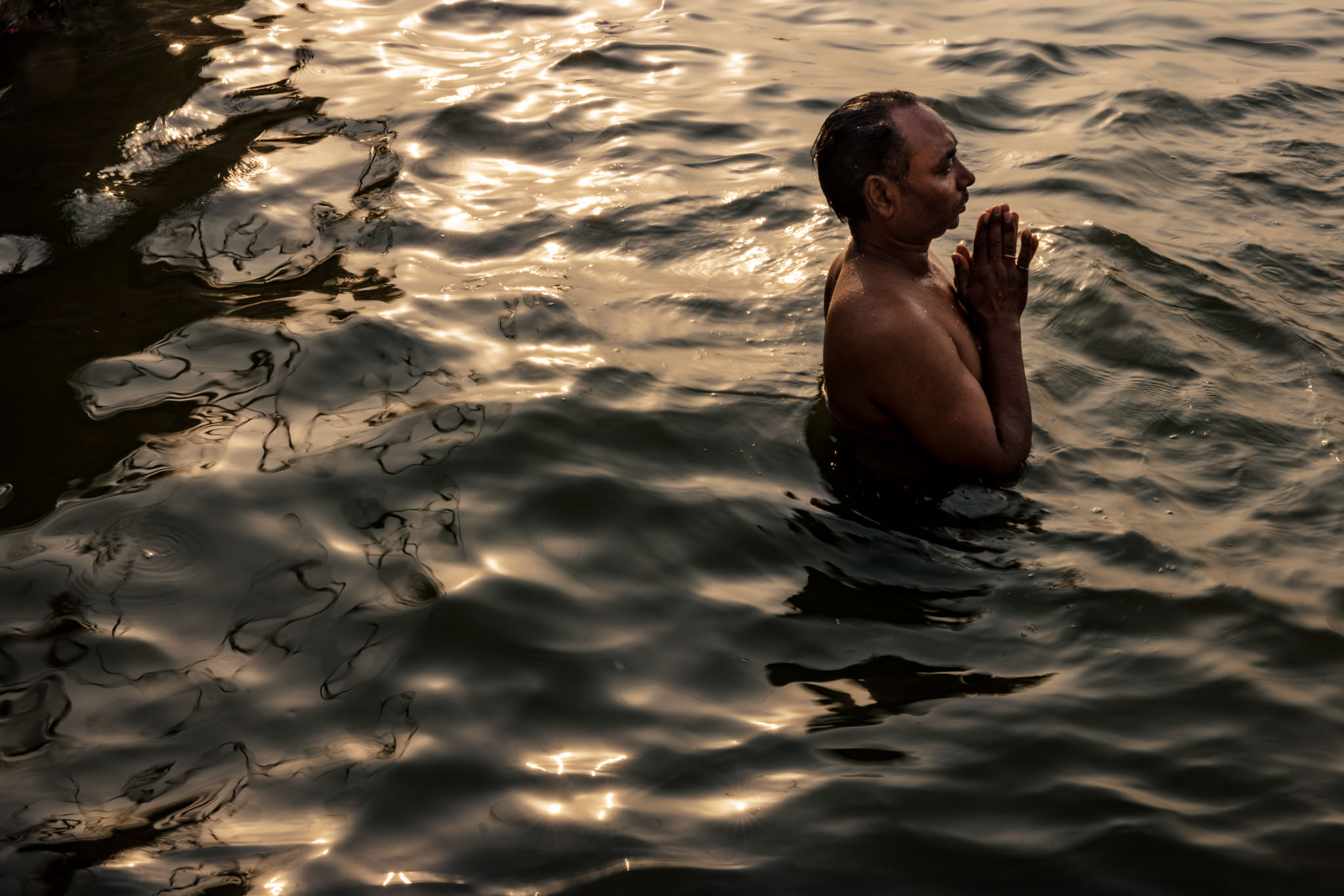
As we walked along pale golden sandstone of the ghats, the sky gradually shifting from dusty rose to amber to azure, life happened around us. Hindu worshippers changed clothes and prepared for a bathing ritual that many wait a lifetime and travel for days to perform. Laundrymen and -women stretched bedsheets and clothing out across the steps to dry in the sun. Boats choked out black clouds of exhaust as they carried tourists clad in vibrant orange life vests up and down the riverfront. A huge group of novice Buddhist monks, staggered in position along the stairs like a giant choir, chanted their morning prayers under the guidance of a master. Sadhus held their microphones and sang to the pigeons. Gurus led their followers in rituals and prayers. A dead dog, almost comically stiff with bloat, drifted past in the shadows of stationary boats. A solitary elderly man began steadily swimming out into the flow of boat traffic.
I tried not to let my jaw drop open as we watched people perform rituals that included dunking their heads underwater or sipping water from a river so polluted that stretches of it have been declared ecologically dead due to critically high levels of industrial and human waste. I’ve had my share of baffling sights while travelling, but actually seeing this ritual happen in real life (I’d seen it in videos and photos) was even more perplexing than coming across women’s squat urinal troughs in Indian rest stations.
We headed back to meet up with DJ and, as we strode off into the alleys, I peppered him with questions about life and death on the river and details about several of the city’s temples and ghats. Varanasi is India’s most holy city and everything has meaning. I wanted to know about the primary goals of pilgrims (answer: temple first, bathing in the river second, aarti third); about the impact of so much pedestrian traffic on local life; about the function of each temple; and most of all, I wanted to understand more about the cremation rites, since Varanasi is the place for Hindus to achieve moksha (liberation from the cycle of reincarnation), and the city is deeply steeped in socio-cultural ritual surrounding death.
During our time with DJ, we visited Manikarnika Ghat, the city’s primary Hindu cremation site, but we also paid several visits independently to Harishchandra Ghat, the cremation site for all other citizens (as well as Hindus), and watched the roles of several key people in attendance so that we could better understand the rituals of these sites, which operate 24 hours a day.
The Dom community is the group traditionally tasked with preparing funeral sites and conducting cremations, which includes ensuring that the pyre site is swept completely clean prior to a cremation and that all traces of ash are delivered into the river post-cremation. The Dom Raja is responsible for overseeing the cremation site and the holy fire, which is the flame that lights all cremations; he’s also the only person allowed to keep any valuables found after a cremation is complete. Interestingly, the Dom community play a critically significant role in Indian society, and yet they’re regarded as being so low on the class scale – during the time of the caste system, they were counted as “outcaste” – that the moment they step away from the ghats, they’re seen as worthless. Addiction is rife among this community, as the men struggle with the realities of their roles.
The chief mourner is a family member who leads the rituals and prayers, and is responsible for lighting the fire. This person is usually a son or sometimes a brother – but never a woman unless there’s no other family, since women are believed to have less control over their emotions. Crying during a cremation is forbidden as it may cause the soul to feel conflicted about departing.
Bodies are sometimes delivered by boat and other times on foot. During our time in the city, we watched as a stretcher was carried awkwardly overhead by a collection of men around tight corners and along the narrow alleys, and I watched a boy of no more than 14 stand watch over a shrouded corpse resting on the riverbank in front of Harishchandra Ghat. Bodies will make it to their final resting place by any means necessary.
The city’s myriad alleyways are notoriously difficult for visitors to navigate – even locals sometimes get lost in the narrow passages, which are often only 3-5’ wide. Thankfully, Rich is an exceptional navigator, so we comfortably dove into the alleys to get away from the main street hordes. The added bonus to this is that the main streets are fully exposed to sun, while the alleys offer respite from the ever-increasing heat, so not only did we manage to stay cooler, but we also got to absorb smaller details about the city, its rhythms, and its inhabitants.
I found it challenging to figure out what I wanted to photograph during our first couple of days in the city, but ideas began to form and I kept quietly sketching away at my ideas through my viewfinder. As I got bolder, I got increasingly closer to worshippers as they bathed in the river. During my last dawn visit, I was photographing the flame in a floating offering when a man asked if I would take his photo. That then spawned several other portraits, and I realised that my own fear had been getting in the way of me making some of the photos I’d wanted over the past few days. Many of these people have saved up for years to finally make their pilgrimage and its an honour for them to be there; being photographed – even when they aren’t going to receive the final product – is their way of marking the occasion.
Varanasi is likely India’s most confronting city: it’s where you see much of the country’s culture, both Hindu and sociological, converge in one place. It’s simultaneously loud, crowded, dirty, chaotic, peaceful, smelly, inviting, friendly, and profoundly religious. I think it’s safe to say that visitors get out of Varanasi exactly what they look for. Want to see the dirt and chaos? It’s right there, ready to slap you in the face or shove you along the pathways. Want to be absorbed by the religious ceremony? Park yourself at the nearest ghat and just watch what unfolds in front of you. Want to find peace in a city teeming with people? Dive into the narrow alleys and turn left where others turn right; a quiet encounter with a cow or a seemingly undiscovered temple might be waiting around the next corner.
The chaos of Varanasi made Ahmedabad feel like a cakewalk. While we were with DJ, I enjoyed getting his thoughts on whether Varanasi is better as a starting point or as a finishing point for a trip to India. His opinion: start in Varanasi because, once you’ve seen that city, nothing in India will surprise you. Only in Varanasi can you set out for a walk, have to change direction to avoid an alley blocked by a cow, then duck to avoid a body being carried through, then witness open-air riverside cremations before casually walking off to finish your excursion with a light and refreshing lime soda like it was just any other day.
India, you’ve been wild, but you really came in with a strong finish.
From here, it’s a quick 35min flight to Kathmandu. The mountains are calling.
Grateful for: no sense of smell