
**If you’re looking for accompanying photos, you’ll always find them here.
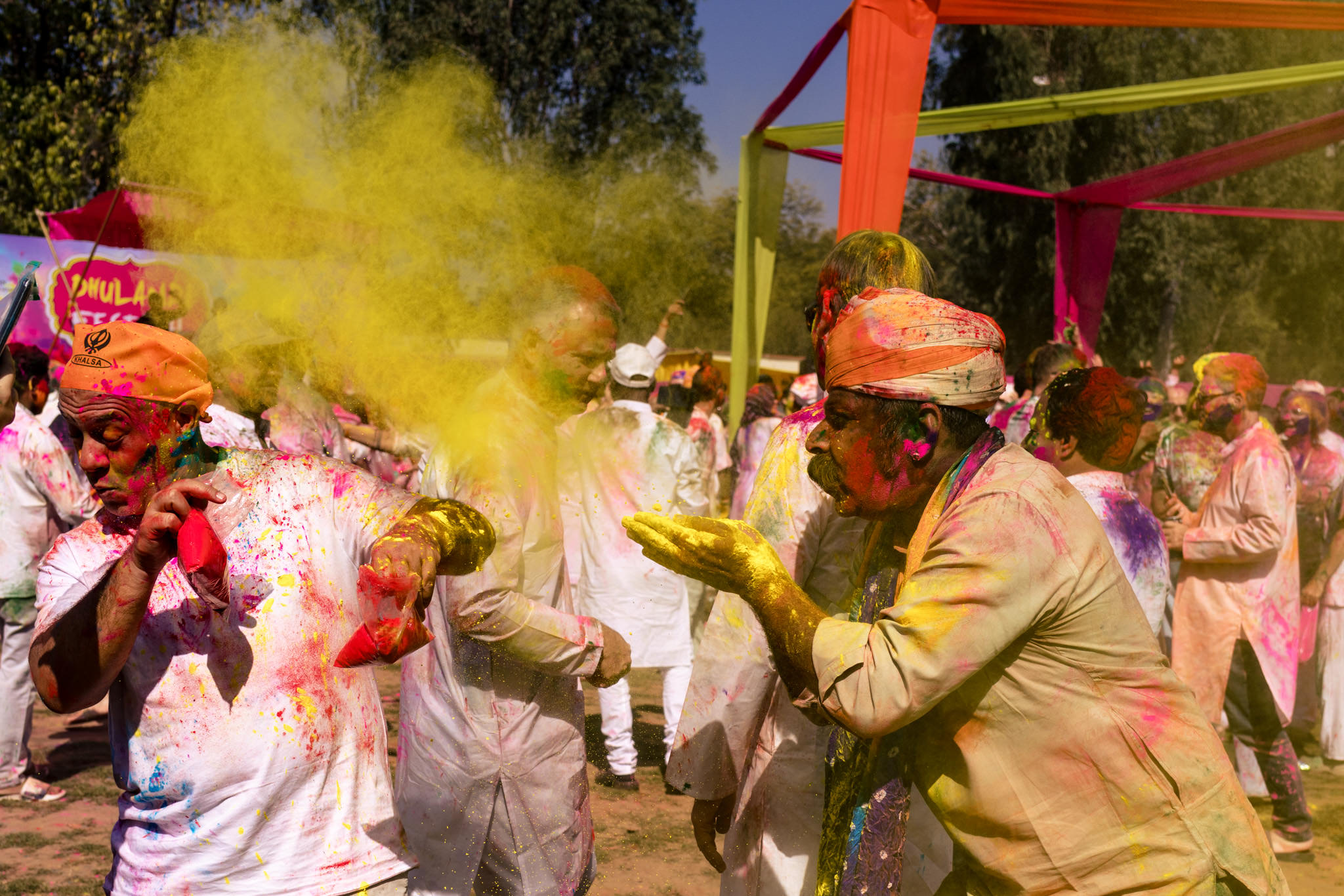
The time had come: Holi was happening. When planning this trip, my one criteria for India was that we had to be there for Holi because I’ve been wanting to photograph it for years. Holi is the Hindu spring festival: a celebration of colour, rebirth, the triumph of good over evil; and the release of old grudges – and that all comes in the form of vibrant dye powders. Okay, that’s over-simplified, but that’s how most Westerners would recognize it.
We booked four nights at Gypsy Monkey, a hostel that showed a beautiful rooftop and pool that was about 15mins on foot from the train station. The reality? An unfriendly welcome, common spaces cluttered with painting supplies and other random detritus, a rooftop pool whose water was that inviting combo of cloudy and questionable, and seating areas with cushions seemingly five years past their prime. I immediately checked the bed for signs of infestation, but we were clear on that front, at least. Little victories?
Our city explorations started with heading to a nearby restaurant; the interior, menu and resulting prices all contributed to the realization that Jaipur is considerably fancier than anywhere we’ve been so far. Jaipur is one of the classic Rajasthan itinerary stops and it was clear that they were used to the influx of money.
Our primary focus while in Jaipur was celebrating Holi, but things got a little unclear when we started trying to make a plan for when we’d be celebrating. Astrology is extremely important in Hinduism, and the date for Holi is decided based on the lunar calendar. Things got a little tricky this year because there was a full moon that factored into date selections, so some areas celebrated on March 3, while others celebrated on March 4. No one seemed to mind having an extra day added to their celebrations!
Holi is marked in two ways. First comes Holika Dahan, which is marked by community gatherings to light bonfires at 1:30am (the nearest was 15’ tall and immediately below our hostel room window – we could feel the heat through the glass!). The bonfire symbolizes the defeat of evil and represents the story of Prahlad, who survived a fire that was meant to kill him. The rituals include singing, dancing, making offerings of grains and other goods, circling the fire, and prayer, and then community members take the opportunity to socialise while the fire burns.
The second part is Rangwali Holi, a playful celebration involving dye powder, water, music and plenty of playful spirit. Hindus refer to it as “colour play” and we were often asked if we “played Holi” which seemed like a cute translation that highlighted the true nature of the celebrations.
At its heart, Holi is celebrated with family and neighbours, not all that dissimilar to the approach we take to trick or treating. There’s often a host family or home base for the celebrations, and then some movement around the neighbourhood as people visit and offer well wishes. Since starting my travel job, I’ve worked on a few itineraries in India and Sri Lanka, and I’ve been using this trip as a chance to meet some of our industry partners, especially the company we work with in India. They were kind enough to pair us up with a local family who would host us for Holi celebrations at their home so that we’d get to experience this traditional form of Holi, which is otherwise difficult to do as a foreigner.
Our day started with a run around Central Park and then some pretty decent tea in extraordinarily questionable cups on our hostel’s rooftop terrace. We met our host from my partner company downstairs and excitedly set off to experience Holi, starting with a stop at the Rajasthan Tourism Board’s event for tourists. I thought it would feel contrived because the event isn’t actually meaningful to attendees. However, there was just the right balance of locals courtesy of the tourism board and local tour companies who were bringing tourists to the event that their authentic joy spread like a contagion amongst an already-excited crowd of foreigners. The event is, in essence, a giant, sober, daytime rave – the DJs were absolutely knocking their sets out of the park, everyone was excited to be there, there were confetti canons being set off periodically, and dye powder was everywhere.
From the tourist Holi, we travelled through town to our host family’s home and were welcomed like visiting cousins. We donned white “pyjamas” (to save our clothes), put on various hats and fun glasses, and tentatively dug into trays filled with vibrant hues of powdered dye as Indian music played in the background. Gradually emboldened, we powdered our hosts, their son, and their visitors between bouts of laughter and rounds of playing with coloured smoke bombs. Dirty, wholesome fun. We shared drinks, including thandai, which kind of reminds me of masala egg nog; enjoyed a beautiful lunch, although I found myself struggling to eat very much; and met two British sisters, a Mexican couple and the husband’s mom, who were all travelling in India with the company hosting me. It was interesting to hear the differing itineraries and experiences between songs and our bouts of terrible attempts at Indian dancing.
One thing that surprised me was the way in which the dye powder is used. Based on previous experiences with New Year and Easter festivals in Peru, Bolivia, and Laos, I had imagined it being thrown with some degree of aggression and had, in fact, fashioned a Ziploc case to cover my camera and a simple 28mm lens that I’d brought along to reduce the risk of powder infiltrating any moveable parts of my gear. For the most part, I needn’t have worried. Most Indian people we saw playing Holi did so by taking handfuls of paint powder and smearing it on the face and hair of their companions – a surprisingly gentle and consent-led gesture. There are, of course, situations where people spread powder on strangers and it seemed heavy on the play and lighter on the gentleness, but the intention was always honest, which was interesting to see even in large crowds.
After a couple of hours with our hosts and their family, it was time to go home. We headed for the rooftop patio with some rum and planned to head out and see what was happening in the area afterwards. As we sat on the deck chairs, we began to feel gradually unwell and, by about 4pm, it was clear that we were going to have to abandon our plan to explore and retreat to bed. We had hoped that a nap would improve the situation, but by early evening it was also clear that neither of us were getting any better, and it stayed that way through the night. I managed to get a couple of hours of sleep not long before sunrise, and groaned when the alarm went off. We were being hosted by my partner company for a full-day city tour and I wasn’t about to cancel.
Brave faces firmly in place and rooftop tea completely avoided, we headed to the lobby to meet our guide and set off. Our tour included Amber Fort, Jantar Mantar, and City Palace, along with roadside stops to see Hawa Mahal (now a hotel) and the water palace (not open to visitors). Our guide, Vishnu, was clearly enthusiastic about sharing his love for the palaces and the observatory with visitors; we did our best to mirror his enthusiasm, but I suspect he could see the cracks in the façade. There were plenty of bright points, both literal and figurative. Hawa Mahal’s perfect symmetry ended up being my favourite building in the city. The sight of the floating palace marooned out on the lake felt like a dare to potential invaders. I was awed by the spectacular grandeur of Amber Fort rising sharply from the water as comparatively tiny red-blanketed elephants carried visitors up the 198 steps (those steps were oodles of fun in full sun with guts that were plotting a rebellion, I assure you). The astronomical observatory of Jantar Mantar was actually surprisingly interesting, even if it appeared to be the same temperature at which I bake sourdough and the entire collection of white marble structures seemed to be only fractionally less bright than the moment a star is born.
Breathing a quiet sigh of relief at having made it through the day without colonic embarrassment and sharing a moment of laughter with our guide about the fact that our hostel was far from the typical hotel drop-off point for our luxury travel clients, we bid him a fond farewell and collapsed into bed. Having passed countless dyed locals and foreigners throughout the day, we had hoped to go out and join today’s festivities, but we were in absolutely no condition to manage it. My heart broke a little, but it’s hard to regret not doing more of something when you’ve already seen it in two different forms and your body is in obvious stages of revolt.
The following day featured a tentative but brighter start; we both felt like we were on the mend and capable of handling our separate plans. Rich was going to the dentist because he’d run out of time to get some work done before leaving home; I had an actual work day and was going on a hotel tour to various 5-star properties in the city. We reconvened to swap tales later that afternoon and headed to the rooftop bar of a nearby hostel so that Rich could have dinner and watch England play India in an important knock-out game of the T20 Cricket World Cup while I worked on digesting the incredible lunch thali that I was served at the gorgeous Oberoi Rajvilas.
I went to bed feeling optimistic. I wasn’t fully better, but figured the only cause of my malaise was over-eating an incredibly rich meal, and Rich seemed to be over whatever had knocked us flat. We had plans for the morning that included checking out of our hostel and moving to a nearby hotel that I was staying at for work research, then setting out on a birthday tour of various restaurants and cocktail spots. Tough!
When I woke up the following morning ready to make the most of Rich’s birthday celebration plans, I quickly learned that the Birthday Boy was anything but over his GI issues. We pivoted our plans and slowed down our morning. Walking to Shahpura House would’ve normally been our choice, but we opted to take an auto so that we didn’t cause alarm by showing up at a 5-star hotel in a state that belied Rich’s intestinal distress. The water was calling Rich’s name, so we parked ourselves poolside and made minimal effort to move for the rest of the afternoon. Never one to cancel a night out, though, Rich decided he was going to soldier on with modified evening plans and see how it played out. He chose Bar Palladio, which offers cocktails in a beautiful courtyard, and then we headed to Townsend for dinner. I laughed aloud at the sad irony of seeing the person who loves Indian food more than anyone I know peruse a menu in India in order to find the blandest possible item for dinner. Nothing was going stop him from having a couple of cocktails, though. What a trooper. 😉
Our auto driver back from dinner was really lovely and also actually a good driver, so we asked him about pricing to go out to Panna Meena ka Kund – a stepwell way in the north part of Jaipur. He agreed and gave us a really fair price, which is completely unheard of when asking auto drivers for rates, so we happily made a plan for 7:30 the next morning.
The morning light was so perfect that we made impromptu stops at Hawa Mahal and the Amber Fort once again, just to see each in beautiful light, then carried on north to the stepwell (because we all know by now how much I love a stepwell). The stepwell was absolutely worth the trip; we spent about a half hour watching the sun gradually creep into its depths and create contrast where there had previously been none. To make the adventure that much better, our driver said he’d like to take us to a nearby temple, which was a gorgeous white and red marble construction complete with intricately carved elephants and deities. We crept inside as a group of women were engaged in morning prayers and soaked in the atmosphere. When we leave India, one of the things I’ll miss most is the gentle, high tones of small bells and cymbals during the morning aarti.
We were back at the hotel by 9:30 and, while we had one more whole day to do with as we pleased, we had guts that said we’d do what they pleased, thank you very much. We lounged by the pool and got our bags ready for the following day’s departure.
Jaipur didn’t end up being what we’d hoped, but also offered us much more than what we’d expected – an interesting combination that, in many ways, is so reflective of the true nature of travel. We can’t control all of the variables, but we can control how we respond to the circumstances we find ourselves in – even if they’re, quite literally, crappy.
Grateful for: locals who treat you like family