
**Grab something to drink and sit with me for 20 mins because this one’s my longest post to date! As usual, supporting photos can be found here (look for the post with the matching lead photo).
While in Kochi, we had to spend some time making decisions about what would come next. Travelling with little plan in place means that you’re free to go where chance leads you, but it doesn’t mean that you never have to make a decision.
We had been in the process of debating whether heading south to cruise the backwaters of Alleppey in a houseboat for a couple of nights sounded like a great idea. Rich also got an invitation from a co-worker in Cornwall to go to a small city not too far northeast of Kochi to attend a Hindu festival, which I’ve since learned is called the Perunnal Vedikettu (I think!). Doing both didn’t make a lot of sense, so we kept reading and formulated a plan to go to the festival and replace the houseboat stop with a quiet place further north that made more geographical sense. (Keep in mind that these are the same two people flying from South Asia to Morocco before flying to Japan – we don’t always opt for the route that makes the most geographical sense…). If there’s one thing we’ve learned in all these years of travel, it’s that if someone extends an invite to visit them or their family in a foreign place, you should do everything you can to accept. So we did.
An early alarm, the world’s slowest taxi, and a drive that was seemingly the wrong way down a one-way street followed by a 17-point turn, and we were on our way to find Jagandh’s cousin, Niranj, and friend, Rahul. We had no idea who we were looking for, but since we were the only white people around, we figured they’d have no trouble finding us – and we were absolutely right.
We made rather shy conversation as we got underway; I was still getting used to the Keralan accent so missed every 3rd word and we weren’t yet sure how much English Niranj and Rahul spoke, so were trying to keep questions and answers relatively simple. Why I didn’t resort to Google Translate to make this part of the day possibly easier for everyone is beyond me, but we figured it out gradually.
Our first stop was one that advertises itself as an elephant sanctuary and mini zoo, which was home to a couple of very large herds of white spotted and sambar deer, along with seven elephants. It ended up being a good lesson in learning to accept what’s in place without judgement, but it was a little bit challenging to read the signs explaining how the facility owners trapped their elephants. The facility trains elephants for ceremonies, which made it a useful stop because it explained a little bit about how the elephants we’d see later that day come to be trained well enough to withstand the commotion of the festival.
After a little wander, we headed for Athirappilly Falls, which are considered (by Keralans, at least) to be like the Niagara Falls of India. In the monsoon season, the river flow is impressively high; in the dry season (now), the river is much lower and creates all kinds of natural pools that would be so much fun to scramble around and between, and is clearly a popular destination – the river was busy with local families who made a day of it. At the bottom of the falls, we got our first real taste of just how much Indians loooooove the casual selfie. It was kind of entertaining to see how many different poses were struck in the space of about 10mins, while I inelegantly clambered around on the rocks and Rahul and Niranj each played photographer.
We had to walk down a trail for maybe a kilometre to get to the falls, and I’m not going to lie: I felt vindicated when I saw lots of locals sweating and panting on their way back up! Having earned a little break, we stopped for ice cream and laughed as we had to vacate our spot under some shady trees because some equally shady macaques started sizing up Niranj’s snack. One had activated stealth mode and was perched on a branch not far over his shoulder, so we gave him a heads up that it was time to move when it dropped the nonchalant posture and started actively watching his treat.
From Athirappilly, we had a longer drive to get to the town where the festival would be happening, so we made a lunch stop. As we sat down, we quickly realised that we’d set ourselves up for a crash course in one-handed eating, a lesson we’d put off while in Sri Lanka, but one we knew was coming for us eventually. Sri Lankans, Keralans (no clue yet about the rest of the country) and Pakistanis eat without cutlery and only the use of their right hand, and we’d learned that there’s a process of actively mixing and manhandling (woman-handling??) your curry and rice because the belief is that the heat from your hands activates oils in the spices, which releases additional flavour in your food.
Perhaps needless to say, we didn’t have an entirely tidy entry into the eating style, but we were steadfast and committed in our efforts to learn. Rahul made a lighthearted observation that my curry-and-rice eating style is remarkably similar to the British stereotype of drinking tea – pinky up! I took the note and aimed to do better next time.
At the end of the meal, we also got to try payasam, a broken-wheat, Indian-spiced version of a loose rice pudding; sambaram, which is a tangy, savoury and spiced buttermilk drink served in very small metal cups; and another drink whose name I haven’t been able to figure out, but it might’ve been tival – it was mostly savoury, with curry leaves, and various other small bits and pieces lurking in the cup. Each drink was a little disconcerting to look at, but the flavours were so interesting – entirely unlike anything we have in Western culture.
Back in the car, we still didn’t really know what we were heading towards, other than something that went on for 12hrs and involved a lot of drumming. Not for the first time this trip, I laughed to (and at) myself about the fact that maybe it would be a good year to work on asking some questions about the details… For the time being, we’d continue to be delighted by surprises.
As the day wore on, I became increasingly aware of the bumps that had begun appearing on my arms. By lunchtime, they were taking shape as individual marks and by midafternoon, they formed the distinctive trail that only indicates one thing: bed bugs. Clearly, our hostel in Kochi was going to leave a lasting impression on me.
We pulled up at a beautiful home, which we quickly learned belonged to the family of Anu (Jagandh’s wife), and we were welcomed like long-lost relatives. Juice and treats were put out, we shook lots of hands, and tried to make conversation while also finding our bearings. As a gesture of thanks for hosting us, I asked if I could take some family portraits with everyone on the front step. I quickly realised this meant about 15 people (family kept arriving while we were there – clearly, having Jag’s friends visiting elevated us to celebrity status), including Grandma and Grandpa. I learned the latter is 93 and cycles every day! I also learned that Grandma has a crush on Rich. 😉
Family portraits quickly devolved into photos with us, but there was lots of laughter, some general confusion, and about 17 different group arrangements before we headed back inside. To more snacks. Every time I turned around, there was another plate of food and another auntie offering me a bite of something. Being that we’re in India to eat, I was happy to oblige…until I realised this really was only supposed to be a snack. You know, an 8-course snack. I thanked all of the aunties and became best friends with the master chefs, who spoke no English but definitely understood the compliment and giggled happily at the newly acquired nickname.
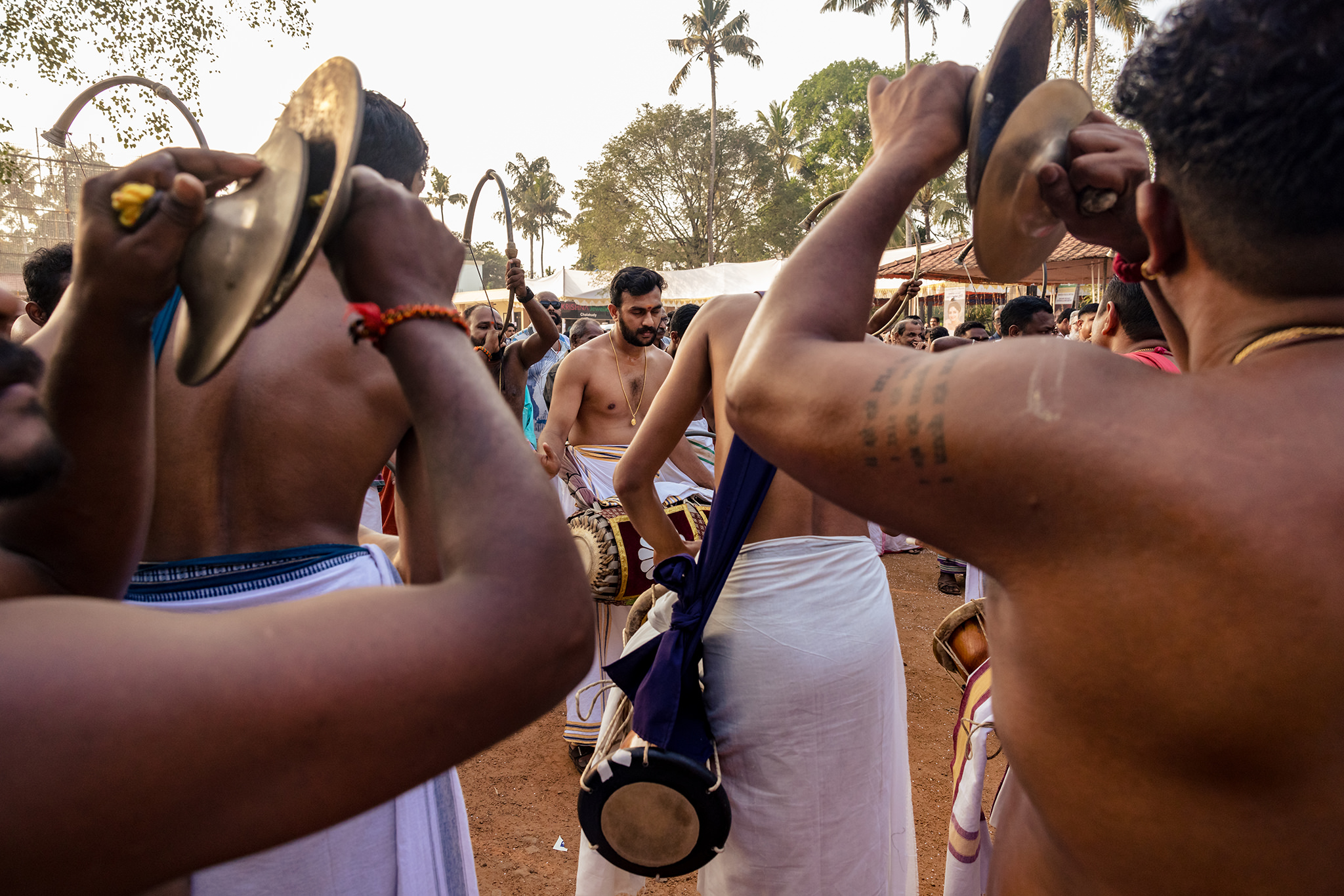
Soon, it was time to head to the festival, so Niranj, Rahul, Shibu (Anu’s Dad) and one or two uncles accompanied us to the temple grounds, where we were led to a spot up front to see the panchari melam. Panchari melam is a traditional Hindu musical ensemble comprised of about 40-50 men playing five different instruments: horn, three types of drums, and cymbals. The music is based on a 6-beat rhythm and builds in 5 repetitive stages that, if your host chooses the right spot for you, can be felt in the very core of your being. Eardrums be damned – you have to be close to really experience it.
While we watched and tried to figure out the significance of the details, we were able to pick out which musician was in charge of each instrument section, and generally figured out the musical cue for when we could expect the 3 men in their positions on the back of each of 5 elephants to stand up and manoeuvre their assigned decorative item (an elaborately decorated umbrella; 2 oxhair “pom poms”; or 2 large round adorned “paddles”, for lack of a better word). We noticed that the dancing amongst the crowd definitely picked up with the music and that the crowd immediately surrounding the musicians tended to be largely comprised of men, while the women stayed further back.
While we stood facing the musicians and the elephants, the crowd size had swelled behind us and it seemed like the entire town had joined us. Festivalgoers were keen to come say hello and shake hands with the foreign visitors; we complimented the festival organisers on what must be a huge undertaking; and we were even marched around the temple grounds by one festival attendee who said it was his dream to walk a foreign guest around the temple. We didn’t realise how fast he would do this, which made an unusual situation even more amusing as he towed Rich by the hand, waving to friends, and I trotted behind like Donkey just to keep up. I was caught by surprise when we circled back around the front and realised that the elephants and their accompanying paappaan were stepping out of their gates and moving towards us. It’s pretty astonishing to arrive at a festival and see heavily adorned Asian elephants standing there, but I can assure you that “intimidating” doesn’t do the feeling justice when they then start to move. Our hosts had a good laugh when I translated my surprise. Among the people we met at the festival were Latha and Santhosh, Jag’s parents, who’d be joining us back at the house.
On paper, attending a festival that features highly repetitive music doesn’t sound all that enthralling, but when it was time to go, it certainly didn’t feel like four or five hours had passed. But it was time to eat, of course, so off we went.
When we arrived, Latha and I sat at the table and chatted, while Rich got towed upstairs to sit on the terrace with a bottle of brandy to be shared amongst the men. Latha asked about our experiences in Kerala, India, and our trip so far, and she translated for those around us who wanted in on the discussion. There was a lot of interest in our experiences in Sri Lanka, and the food there, in particular, so it was fun to be able to explain the similarities in many of the dishes, the eating style, and the ingredients.
As dishes started being carried out of the kitchen, it was clear that our master chefs had been busy while we were away. Fish fry, biryani, raita, pickle, vegetable curries, chutneys, chicken, pork – you name it, it landed in front of me and I did my best to take small portions so that I could try it all. I told them that fish fry was my new favourite dish, and quietly discovered that pork curries probably aren’t going to be a winner for me as I struggled to swallow the fatty cut of belly pork that they used (which I knew Rich would love). When we started to eat, I confidently used my now-improving eating skills and mixed various items into my rice and dug in, marvelling at how the sultanas in the biryani added little explosions of sweetness to the mix of vegetables, while also becoming gradually aware that the aunties has slowly crept up behind me and were now standing immediately over shoulders, watching me eat in rapt attention, muttering quietly to one another while Latha seemed to watch from across the table.
Ten minutes later, I learned through a casual remark that you mix curry and rice, but never mix biryani. I laughed at myself and noted another lesson learned. I still haven’t figured out how you’re meant to eat biryani without sauce to help it bind together, but I don’t doubt that particular lesson is lurking in our future.
As I folded up my palm leaf dinner plate, I was met with looks of disbelief that I could be full already, while I tried to figure out how on earth they could think I could fit another mouthful in. I patted my belly, and used Google Translate to tell them that if I ate any more, I was going to have to walk to Hampi instead of taking the bus (775kms away). The joke didn’t land quite as well as I expected it to; clearly, I wasn’t eating enough to satisfy the aunties.
Several hours later – after more sweets, more photos, more handshakes, and more stilted conversation, and lots more laughter, we waved an enthusiastic goodbye to Roshitha, Shibu and the rest of the family and headed to a nearby hotel where we’d spend the night in a geodesic dome (pretty cool!). While we got settled, we debated finding a ride back to the festival because the night celebrations are supposed to be especially cool, but after realising that getting home could involve walking 3kms in the dark in an area known to have wild elephants, we decided to make the safe decision for a change and call it a day.
The following day, we’d made plans to go to a local swimming spot, go fishing, have some coconut palm wine, and explore the area with Latha and Santhosh. The swimming spot was much like the pools at Athirapilly Falls, but this time located on the downstream side of a weir that also served as a popular dry season crossing point for motorcycles. I laughed as Rich got adopted by some locals and dragged off for a swim, but not before they waterboarded him under the water flowing over the weir. I watched in slight horror as he swallowed what had to be several litres of local river water, and hoped desperately that this didn’t come back to haunt him on our 9-hr night bus journey later that day.
We arrived at Uncle and Master Chef Auntie’s house to more treats, including jackfruit and achappam – a beautifully delicate cookie resembling a flower, made by dipping a special mold in the batter before dunking it in hot oil – and had a little visit while we enjoyed some chai.
Going fishing ended up being a good opportunity to explain the phrase “like shooting fish in a barrel,” since it turns out that one of the uncles owns a tilapia farm (that explains why we liked the fish so much!) and we were given a rod to take turns plucking a few specimen from the pond containing 12,000 of them. Still, it was a good opportunity for some laughter and our hosts all seemed so thrilled to see us enjoying ourselves (especially Shibu, who was sporting an enormous grin the entire time!).
You’ll be shocked, I’m sure, to hear that we then ate again when we got back from fishing. The answer to “have you eaten” was clearly never going to be “no.” I dug in with enthusiasm and finished at almost the same pace as our family, so felt quite proud of myself. When they tried to serve more, though, I shook my head, patted my belly and said, “Hampi.” They smiled… and forced my portion onto Rich’s leaf.
We had a much slower-paced day that included plenty of downtime before going for a walk in a nearby park that featured a suspension bridge, plenty of monkeys, and a dog that seemed keen to adopt us. I made some photos of the four parents, as well as Ananth (Anu’s brother) and Arjun (Ananth’s friend, who kindly served as our interpreter for the day), and was able to share them with the family later that evening.
We had a lovely visit with Latha and Santhosh in their home (more snacks!), and got a chance to look through Jag and Anu’s wedding album, which was a lot of fun not just from a professional standpoint but also because we now recognised a lot of “our family” in the multitude of group photos.
A late dinner followed by an unexpectedly long wait for our bus, which was running an hour behind our already-late pick up time, and we bid our family goodbye as we threw our bags on the bus and quickly boarded the steps, knowing that we’d experienced something so incredibly special.
A significant language barrier doesn’t make things easy when you’re trying to get to know new people, but Jagandh and Anu’s families welcomed us as two of their own, and demonstrated such kindness, warmth and incredible generosity that we boarded the bus still shaking our heads in awe from what we’d experienced. We still don’t know how we’ll ever be able to return the favour, but we hope to have the opportunity to try.
Grateful for: Tiger Balm and a willingness to say “yes”