
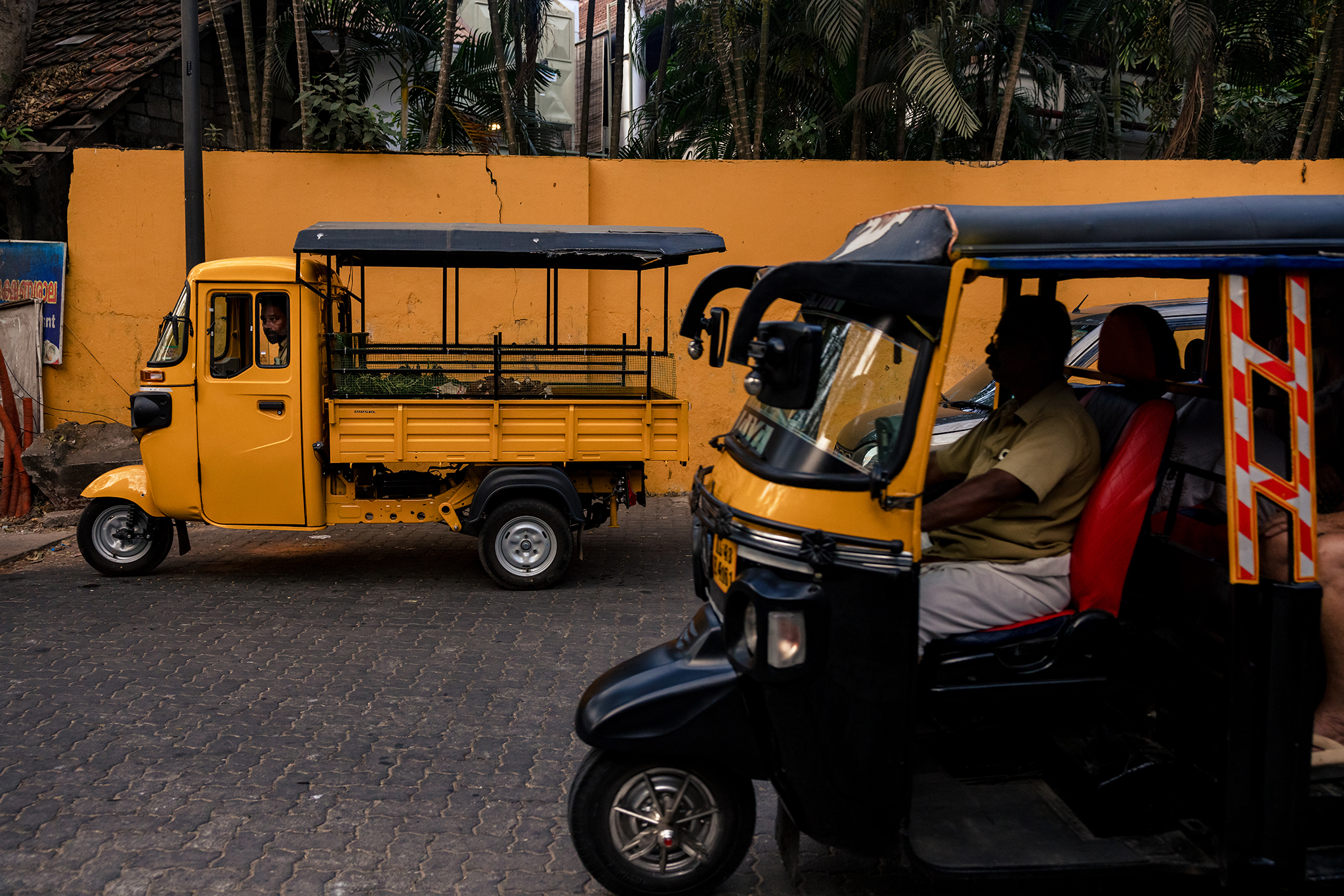
**As usual, supporting photos can be found here (look for the post with the matching lead photo).
By the time we’d navigated the drive to Colombo airport, the flight to Kochi, getting an Indian SIM and the drive to our hostel, it was already time for dinner. Luckily for us, our hostel was right across the road from a particularly great intro to Keralan food AND we managed to beat the dinner rush. Never mind that our table was in a part of the building so dark that it was difficult to see our dishes when they arrived – the taste of our prawn curries and incredibly flaky paratha more than made up for our inability to see it.
Our post-dinner passeggiata resulted in me buying a new shirt to replace the threadbare Thai shirt that I bought in 2004 that has accompanied me on every trip since, and also quickly revealed a key difference between Kochi and everywhere we’d visited in Sri Lanka: they didn’t give a rat’s…uh, behind (hi, Mom) about another couple of Western tourists, and weren’t worried in the slightest about saying hello. It was both disconcerting and slightly freeing to be able to just…walk. So we did! It turns out, though, there isn’t a lot to see in residential Kochi after dark (we went the wrong way to wander past the tourist restaurants), so we used it as a chance to generally get our bearings and knew we’d do better the following day.
Kochi is a major port city in Kerala and was once a major stop on the spice trade, given its location on the Arabian city. When looking at how we wanted to spend our six weeks in India, we had to decide whether we were going to try to get to know one or two states quite well or do a little bit of a lot of things – what I call a “taster tour.” What we quickly learned after arriving in Kochi was that Kerala is also an incredible starting point because food is so central to the culture – so much so that their usual greeting to one another is, “Did you eat?”
We only had three nights there, and we had plans to make the most of our time. Our most important first stop was Decathlon because we had learned something important about our packing choices: our usual approach of bringing cotton clothing that was nearing the end of its lifespan so that we could shed items along the way and replace as needed just wasn’t going to work in the tropical humidity that we were experiencing. It was taking too long to dry based on the pace at which we were moving and, more often than not, Rich was uncomfortable during the day. We replaced a daypack that had worn-out stitching and got a bunch of new quick-drying items that have already proven to be smart purchases. At the end of our stay, we were able to fill the old daypack with items that could find new homes while still useable.
The trip to Decathlon brought two new hurdles: navigating the ferries and the buses.
It turns out that our hostel was almost immediately opposite the passenger ferry, so we got ready, walked straight to the terminal and tried to buy two tickets. Having gotten Indian rupees straight from the ATM, we had a wallet full of 500 rupee notes, knew that $1CAD was equal to about 65INR, and had precisely zero point of reference for how much transit cost. The answer? 6 rupees. A laughably small amount when faced with large bills and tellers who don’t have change. The good news is that our need to break a note led to my first of what would undoubtedly be many cups of masala chai.
Armed with appropriate change, we bought tickets on the next ferry and enjoyed the ride past the cargo ships before reaching the “mainland” (Fort Kochi isn’t an island, but taking the ferry is a far more efficient means of transport off the peninsula) and walking to catch a bus. The bus route info is printed on the buses in Malayalam, not Roman script. Who’s got two thumbs and can’t read Malayalam? You guessed it…. And so, after watching 3 or 4 buses pass by with no idea where they were going, we sprang into problem solving mode. I translated our stop using Google Translate, held my phone sideways to make sure the font was big enough to be legible from a distance, and held it up while calling out our stop to the bus conductor (you often board the bus from the back, so there’s a man whose job it is to circulate and collect passenger payment) every time a bus approached. Got on a bus in no time and got on with our day.
On our way back to our hostel, we decided to stop at Ponjikkara Cozinha for lunch (note the Portuguese spelling, which hints at the region’s history as a Portuguese colony). A decidedly local spot that serves “meals” (vegetarian thalis, to which you can then add items like Kerala fish fry), we laughed at ourselves when our waiter came over and said, “I think maybe you need these?” He held out some forks and we took them, feeling grateful but also sheepish. We weren’t quite ready for the local approach just yet.
The food offered a chance to taste at least a dozen different curried items – bitter gourd (the absolute worst – it’s an overachiever when it comes to living up to one’s name), lemon pickle, green bean and carrots, cassava, snake beans, mango curry, coconut sambol, dal, two different prawn fries and a sea bass fry that rivalled the red snapper from Turtle in Talpe. Just before we finished, our waiter came over and offered us juices. Rich chose green mango and chilli which was, as we quickly learned, salted not sweet, but was amazingly refreshing. We weren’t familiar with whatever mine was, but in the spirit of “Don’t know it so must try it,” I did – and I think it might’ve been the Indian equivalent of horchata? Creamy, slightly grainy, fairly sweet and lightly spiced, it was also completely delicious. We may have overdone it by ordering two different prawn fries, but we left $20 poorer, with swollen bellies and no regrets.
We weren’t in the city for long, but we settled into a brief flow of morning runs along the waterfront past the cantilevered fishing nets (which I never tired of watching and usually went back to see in the evenings), past the outdoor gym and it’s senior members, and under the banyan trees; meals at any and all little spots that caught our attention (the smaller, the better); and lots of walking to see the colonial homes, synagogue, and the antiques shops that are dotted throughout the fort area.
Prior to leaving home, we jokingly encouraged family and friends to place bets on how long it would take us to get sick in India, since we’re prone to trying food that maybe we shouldn’t and figured we were likely to meet our match. We thought we might’ve accomplished this sooner than anticipated when we sought out a spot to try sharbath, a local version of fruit cordial. We sat down at a spot that had pitchers of table water, the provenance of which is completely unknown to us and therefor off limits, and waited for our lime juice. As we sipped our juice, I watched as the juicemaker refilled the water used for juice directly from one of the table pitchers. In for a penny, in for a pound – we finished our juices and headed on our way, feeling like the timer had started on what had to be the guaranteed destruction of our gut biomes.
Surprise! I’m pleased to report that we escaped unscathed (as did our bathroom). I still don’t know where the water comes from, but I know that we got away with drinking that particular restaurant’s water – and we vowed not to push our luck. At least for a few days…
We booked an early taxi for our final morning and zipped up our now-much-lighter backpacks, ready to meet what would soon become new friends.
Grateful for: water quality that was better than we anticipated